
Earlier this year, I finished reading God is a Black Woman by Christena Cleveland, and I highly recommend it. This engaging memoir tells the story of how, in 2018, Cleveland went on an extensive walking pilgrimage across the Auvergne region in France to visit eighteen Black Madonnas. She gave nicknames to some of them that she visited, including Our Lady of Mud, Mother of All Bling, and Our Lady of the Side-Eye. Some of her chapter titles are also names she fashioned for the Sacred Black Feminine, including She Who Cherishes Our Hot Mess, She Who Loves by Letting Go, and She Who is Unapologetically Black. She writes that she made this pilgrimage, because she was in search of the Sacred Black Feminine. As a Black woman and theologian, who taught at Duke Divinity School, she had come to realize that to keep growing and becoming more healthy, she needed to look beyond the “fatherskygod” and “whitemalegod” she internalized in childhood and which are products of patriarchy and white supremacy. God is a Black Woman is a chronicle of Cleveland’s quest for autonomy, belonging, and freedom. It is really satisfying to read how her life expands and she comes to find herself and the liberating Sacred Black Feminine that she was searching for.
In my view, most Black Madonnas project power and strength and a great sense of solidity. By contrast, fair-skinned depictions of Mary are often associated with her traditional nurturing role, humility, and obedience. I wrote about this in my previous blog post Black Madonnas Matter, where you can see a photograph of the very light-skinned statue of Mary with long flowing blonde hair that I received as a gift for my first communion in second grade. In my travels over the years, I have seen Black Madonnas myself, mostly in France. So here is a rundown of some of my photos and experiences in the presence of these beautiful Black representations of Mary.
Andy and I were on vacation in France back in 2007 and we were staying in the small town of Limoux. The guide book had said that there was a Black Madonna there and I was so excited to go visit her, mostly because I had never seen one before and was very curious. While we were in the hotel lobby I noticed a local newspaper (yes it was that long ago) that had a picture of the Black Madonna and, although I didn’t know very many French words, it seemed like it said that something had happened to her, very recently, maybe even that same day. Such bad luck–I had been looking forward to seeing her for the whole trip.
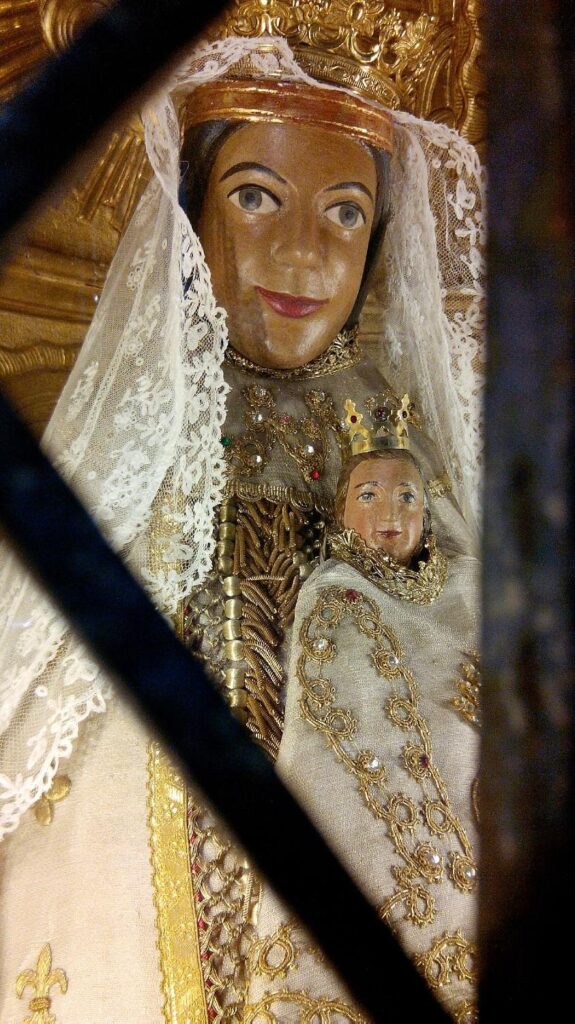
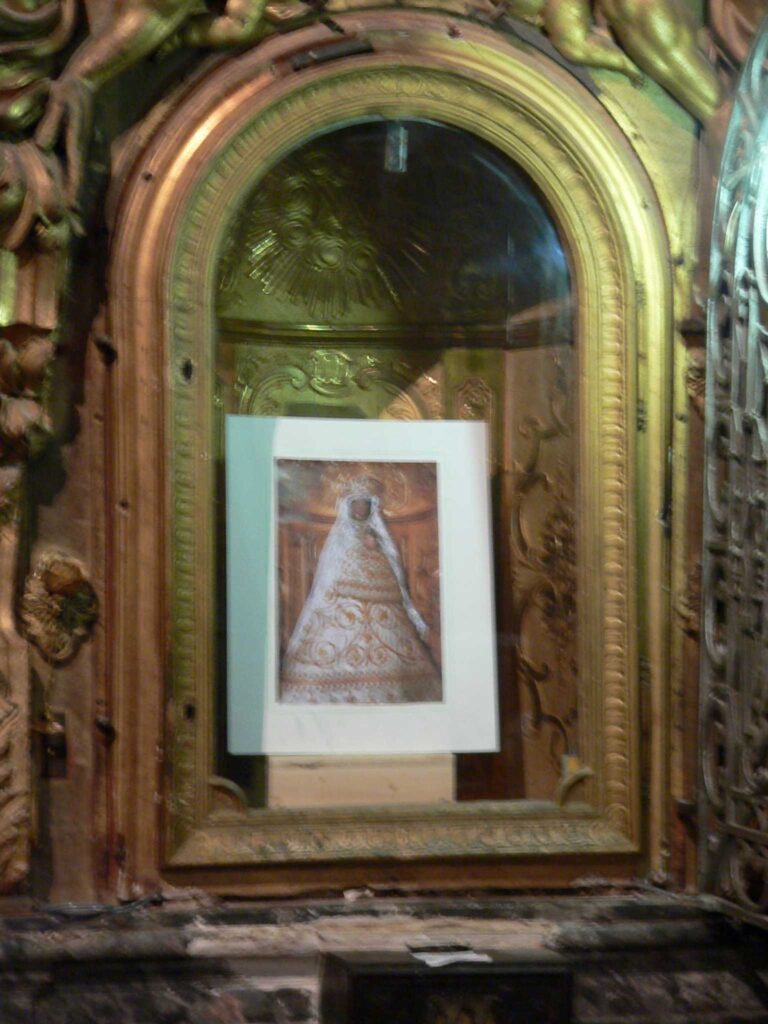
So, of course we went and visited the beautiful fourteenth-century basilica that had been a popular medieval pilgrimage stop, the Basilique Notre-Dame de Marceille anyway. It turned out that her head had actually been stolen, and that the remaining parts had been removed by church staff. There was still police tape everywhere and I was disappointed, but Andy captured the photo in image 2. You can see the niche where she had been displayed before we arrived, with a replacement photograph of the Black Madonna of Limoux in her place. A 2018 tripadvisor review indicates that a replica of the original head was fabricated and she was placed back in the basilica, where she belongs. However, it should be noted that that they have upped security and placed her behind a thick grate. The tripadvisor review posted the photo in image 3, where they managed to get a quick peek between the grating. Maybe we should call her Our Lady of Incarceration — I think Christena Cleveland might approve.
In 2015, Andy and I were fortunate to be back in France and went to the cathedral at le Puy-en-Veley, which was one of the beginning points of the El Camino pilgrimage that travels south to Santiago de Compostela in Spain. Le Puy was a pilgrimage site itself, and we walked all the way up those zillion stairs in the shadows and footsteps of all the medieval pilgrims of the past. When you get to the top of the stairs, you are dropped right into the middle of the cathedral’s nave and it is very impressive.
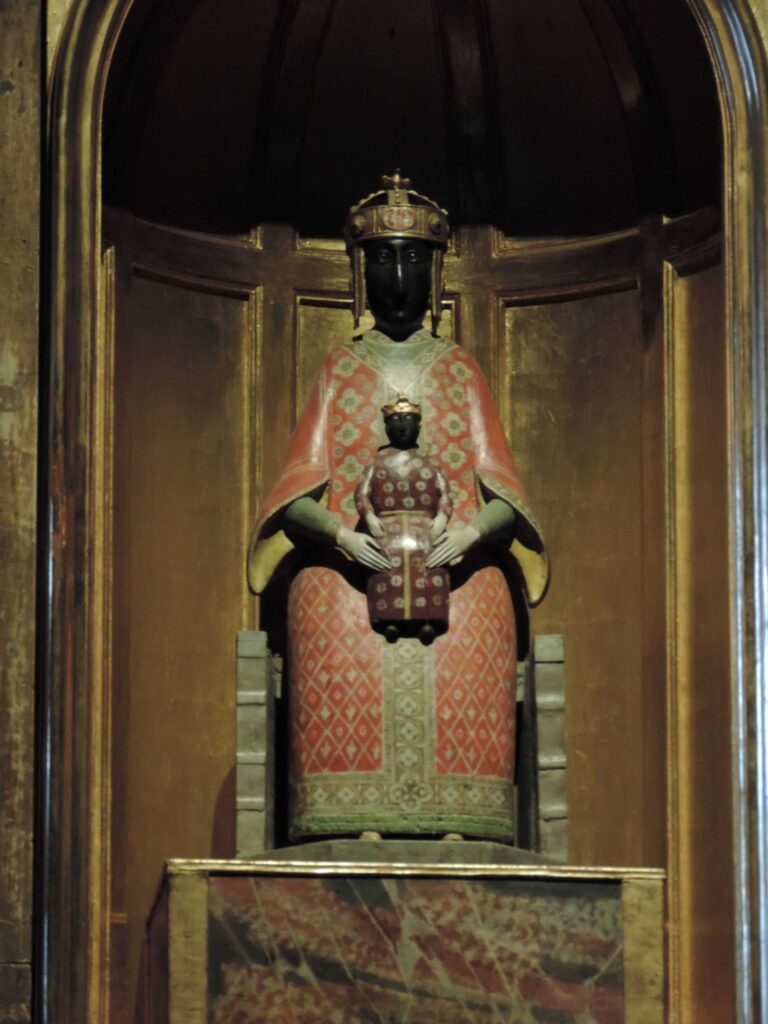
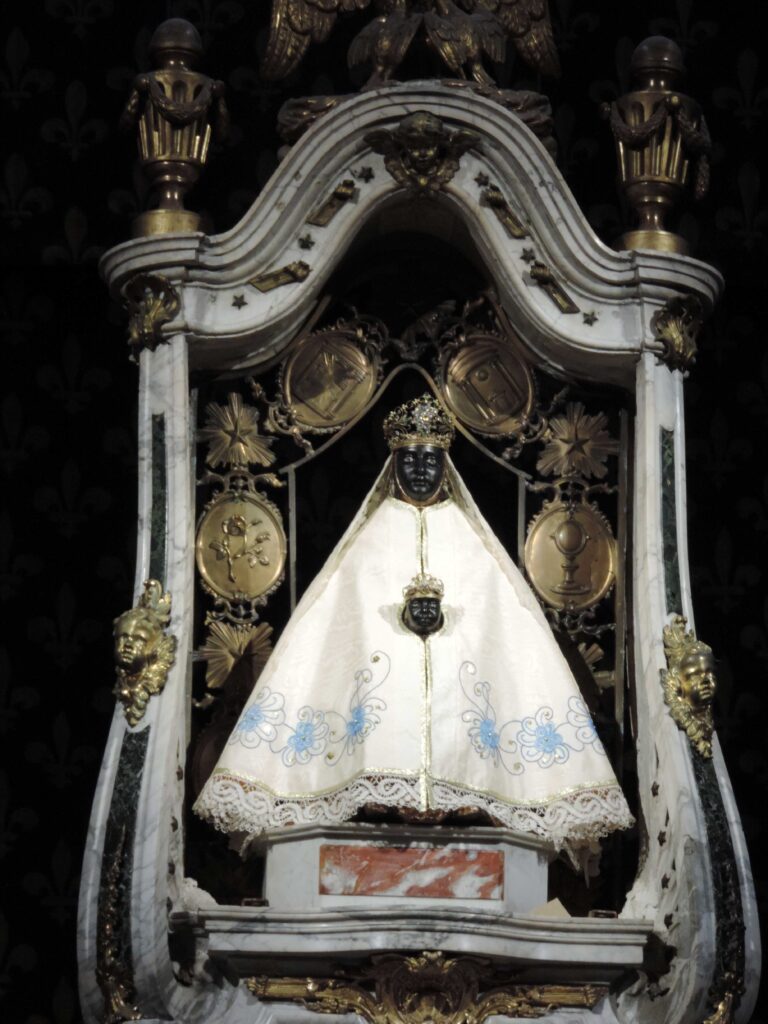
Image 4 is a photo of the Black Madonna that is in the sanctuary of the le Puy cathedral, and image 5 shows a second Black Madonaa that was in a different part of the church. I think there was supposed to be a third Black Madonna somewhere on the church grounds, but I poked around and couldn’t really find her. Since that 2015 trip, I have read that there are “Thrones of Wisdom” which seem to be Black Madonnas that have compartments in the back to hold relics. Supposedly the Black Madonna of Le Puy has a secret compartment that holds Mary’s slippers. And I did also want to point out that, if you zoom in and look closely at the Madonna in image 5, you can see that she has white hands. I am curious about how and why that happened! Weird–someone must have tried to whitewash her or something.
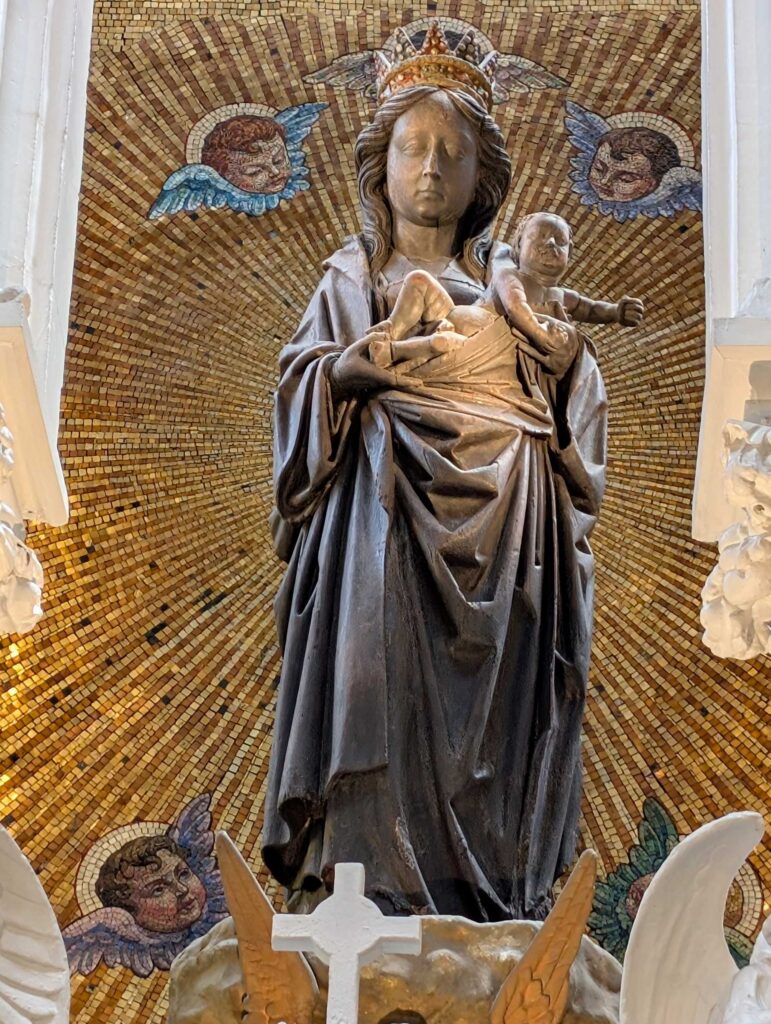
And most recently, I went to see a Black Madonna when I was in Ireland on vacation just this past March 2026. In image 6, you can see her, Our Lady of Dublin. She is located on an elaborate altarpiece in very well-lit side chapel of the Whitefriar Street Carmelite Church. I have decided to call her Our Lady of a Good Night’s Sleep. It looks to me like she is trying to change Jesus’ diaper in the middle of the night with her eyes closed! Seriously. And don’t we all need a good night’s sleep? Seriously!
If you liked this blog post, you might be interested in a previous blog post, Black Madonnas Matter, which I wrote not long after George Floyd was murdered by a Minneapolis police officer in 2020. It includes a discussion of the powerful Black Madonna icon, named Our Lady Mother of Ferguson and All Those Killed by Gun Violence, that was written by Mark Doox in 2015, in response to the fatal shooting of Michael Brown by a police officer in Ferguson, Missouri, in 2014.
Reference 1: Duricy, Michael P. and Krymow, Vincenzina, The Black Madonna: Past and Present, Marian Studies: Vol. 57, Article 10, 2006.
Reference 2: Janet Michello, The Black Madonna: A Theoretical Framework for the African Origins of Other World Religious Beliefs, October 20, 2020.
Reference 3: Christena Cleveland, God is a Black Woman, Amistad Imprint of Harper-Collins, New York, NY, 2022.
Reference 4: Ella Rosett, Black Madonnas: A Comprehensive View, introductory blog post at interfaithmary.net, website, accessed June 7, 2026.
Image 1: Delita Martin, painting incorporated into cover design by Harper-Collins for God is a Black Woman, 2022.
Image 2: Replacement photo of Black Madonna at the basilica Notre-Dame de Marceille in Limoux, Andy Hong, 2007.
Image 3: Review of Basilique Notre-Dame de Marceille in Limoux by “psychprofessor” from Starkville, Mississippi, March 17, 2018.
Image 4: The Black Madonna at Le Puy, Julie Henkener, 2015.
Image 5: Second Black Madonna at Le Puy, Julie Henkener, 2015.
Image 6: Our Lady of a Good Night’s Sleep (Our Lady of Dublin), Julie Henkener, 2026.











Leave a Reply
Join the conversation by submitting a comment to this blog post below.