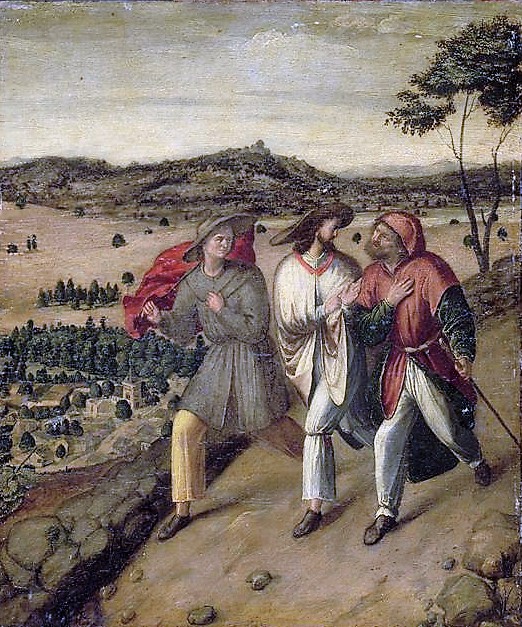
The gospel this morning is the beautiful and familiar story of the disciples that meet Jesus on the road to Emmaus. It is one of my favorite accounts of the resurrection. This blog post explores the Emmaus story, focusing on its four scenes: Encountering Jesus, Jesus Listens and Interprets Scripture, Recognizing Jesus, and Returning to Jerusalem.
Encountering Jesus on the Road to Emmaus
13 Now on that same day two of them were going to a village called Emmaus, about seven miles from Jerusalem, 14 and talking with each other about all these things that had happened. 15 While they were talking and discussing, Jesus himself came near and went with them, 16 but their eyes were kept from recognizing him. 17 And he said to them, “What are you discussing with each other while you walk along?” They stood still, looking sad. 18 Then one of them, whose name was Cleopas, answered him, “Are you the only stranger in Jerusalem who does not know the things that have taken place there in these days?” (Luke 24:13-18)
At the beginning of the Emmaus story, Cleopas and a second disciple of Jesus were walking home, talking over the recent events related to the crucifixion and death of Jesus and the wild news that He might actually still be alive. Some Christians speculate that perhaps the two on the road to Emmaus were Mary and her husband Clopas. It’s definitely intriguing to think the second disciple might have been female, and I even found a link to the Art & Theology website (reference 2) that has posted a number of examples of contemporary art that depict the second disciple as female.
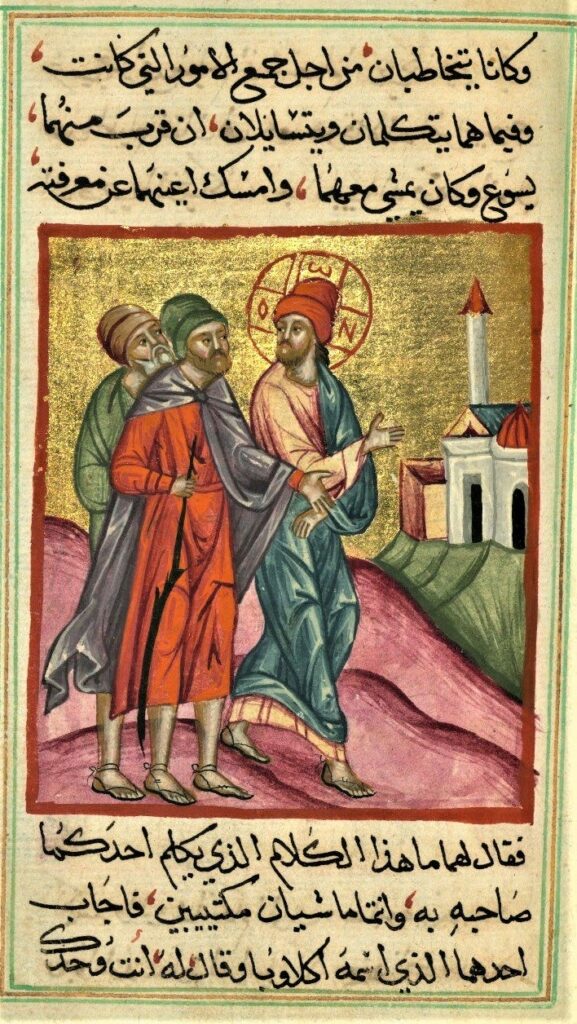
The idea that the second disciple is female can be interrogated by examining the verses that place Mary (one of many Marys in the gospels) at the crucifixion and at the tomb. At the cross, Matthew 27:56 names her as “Mary the mother of James and Joseph,” and Mark 15:40 calls her “Mary the mother of James the younger and of Joses.” Luke does not name specific women at the crucifixion, just calling them “the women who had followed him from Galilee.” Finally, in John 19:25, the author writes that “Mary the wife of Clopas” was also present at the death of Jesus.
In the resurrection sequence, Matthew says that “the other Mary” went to the tomb on Easter morning with Mary Magdalene, while Mark 16:1 and Luke 24:10 both state that “Mary the mother of James” was there with her. And finally, the longer story of Mary Magdalene meeting Jesus in chapter 20 of the gospel of John does not refer to other women being present.
Further complicating matters, this idea that the second Emmaus disciple was Mary, the wife of Clopas, also depends on the theory that “Clopas” and “Cleopas” are the same person. This is the only time the name Cleopas is found in any of the four gospels. It’s thought by some that the name Κλεοπᾶς Cleopas could be a contraction of the Greek name Κλεοπατρος, whereas Κλωπᾶς Clopas seems to be an Aramaic name. So, despite the similarity between the names Clopas and Cleopas, they may not necessarily have the same origin.
The question then is whether “Mary the mother of James” and “Mary the wife of Clopas” and the disciple who walks with Cleopas are all the same person. In reference 1, biblical scholar, Marg Mowczko, expresses three lines of reasoning in refuting that idea.
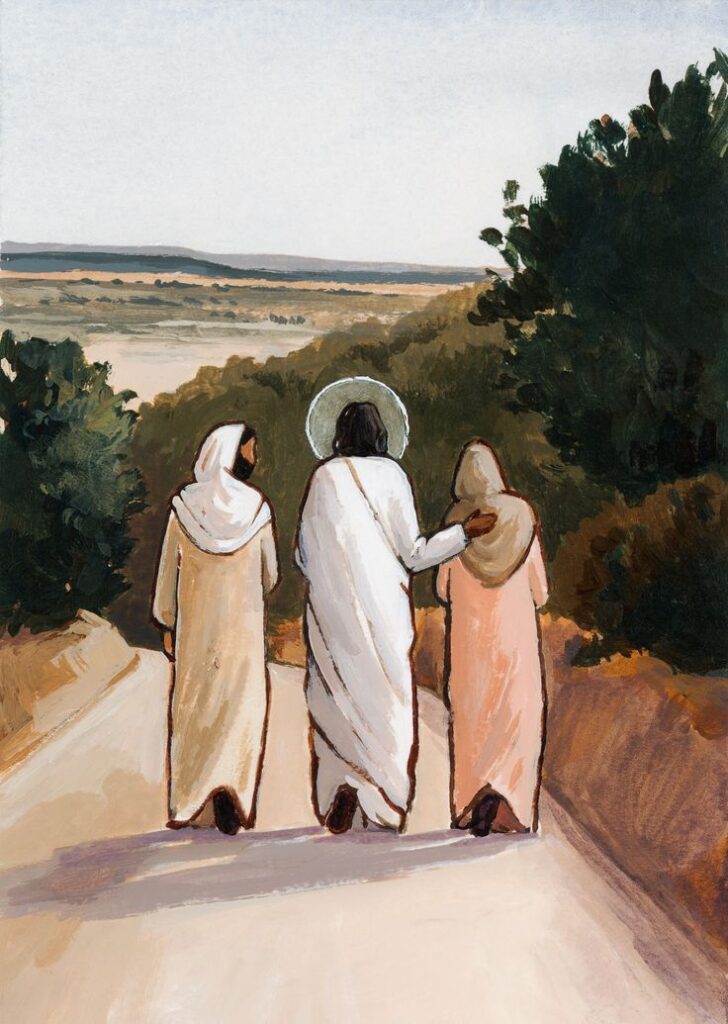
First off, she indicates that Luke often highlights male-female pairs in his Gospel, but in the Emmaus story, he makes no references to the gender of the second travelling partner. This argument is essentially that if the person traveling with Cleopas was his wife Mary, surely Luke would have said so. I find this to be the least convincing substantiation that she proposes.
Her second argument is that Mary the mother of James cannot be the same person as the second disciple, because James was the son of Alphaeus, not Clopas. Alphaeus is identified in Matthew 10:3, Mark 3:18, Luke 6:15, and Acts 1:13 as the father of James. This has led many commentaries to suggest that Clopas and Alphaeus are variations of the same Aramaic name תַלְפַי.
And thirdly, the gospel of John relates that Mary, the wife of Clopas was present at the crucifixion and, if she was also the mother of James and Joses, she would have been among the women at the empty tomb. In that case, it would have been unusual for Cleopas to have spoken about the testimony of these women, if his travelling companion had been among them. He tells Jesus, “In addition, some of our women amazed us. They went to the tomb early in the morning but didn’t find his body. They came and told us that they had seen a vision of angels, who said he was alive. Then some of our companions went to the tomb and found it just as the women had said, but they did not see Jesus.” And of course, if the second disciple was this same Mary, she might have spoken for herself.
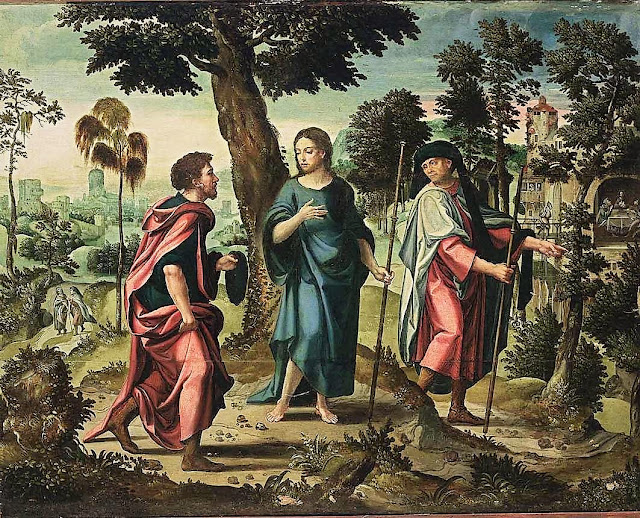
These last two arguments are much stronger and make sense to me. Mowczko concludes, “Nothing in [the Emmaus story] hints that Cleopas was travelling with a woman, let alone a woman who had seen the empty tomb and heard the angels’ message of the resurrection for herself.”
Jesus Listens and Interprets Scriptures
19 He asked them, “What things?” They replied, “The things about Jesus of Nazareth, who was a prophet mighty in deed and word before God and all the people, 20 and how our chief priests and leaders handed him over to be condemned to death and crucified him. 21 But we had hoped that he was the one to redeem Israel. Yes, and besides all this, it is now the third day since these things took place. 22 Moreover, some women of our group astounded us. They were at the tomb early this morning, 23 and when they did not find his body there, they came back and told us that they had indeed seen a vision of angels who said that he was alive. 24 Some of those who were with us went to the tomb and found it just as the women had said; but they did not see him.”
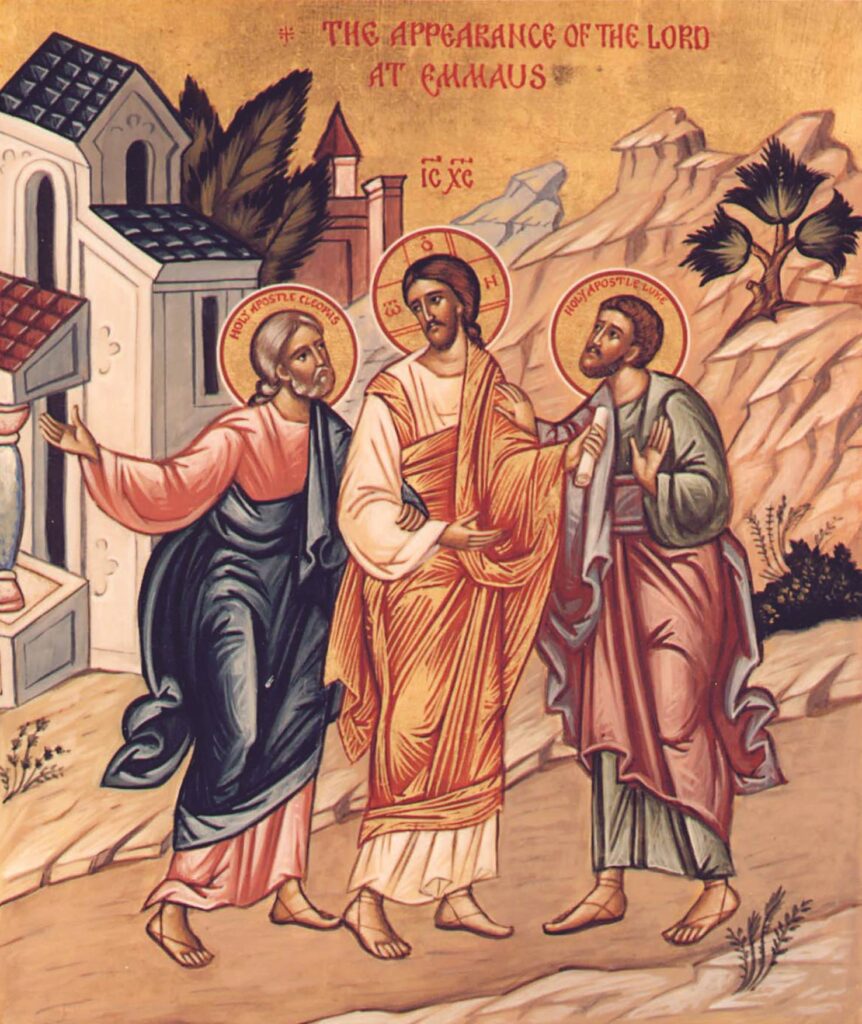
25 Then he said to them, “Oh, how foolish you are, and how slow of heart to believe all that the prophets have declared! 26 Was it not necessary that the Messiah should suffer these things and then enter into his glory?” 27 Then beginning with Moses and all the prophets, he interpreted to them the things about himself in all the scriptures. (Luke 24:19-27)
In the second scene of the Emmaus story, Jesus listens compassionately to the disciples and then interprets scriptures for them. One of the great themes of this reading from the gospel of Luke is the juxtaposition of absence and presence. We can observe this connection as Jesus walks along with them. He begins by asking an open-ended question: “What are you discussing with each other while you walk along?”
It was evident that the disciples were heartbroken, feeling absence, loss, and grief. They were struggling to find meaning in the death of Jesus on the cross and trying to figure out how to move on to whatever will be coming next. Their hopes for a Messiah and a certain kind of coming of the reign of God were completely shattered. They were also confused. They had heard the story of the women and the empty tomb but could not understand or believe it. As they continued their journey, walking away from Jerusalem, they emptied their hearts to Jesus.
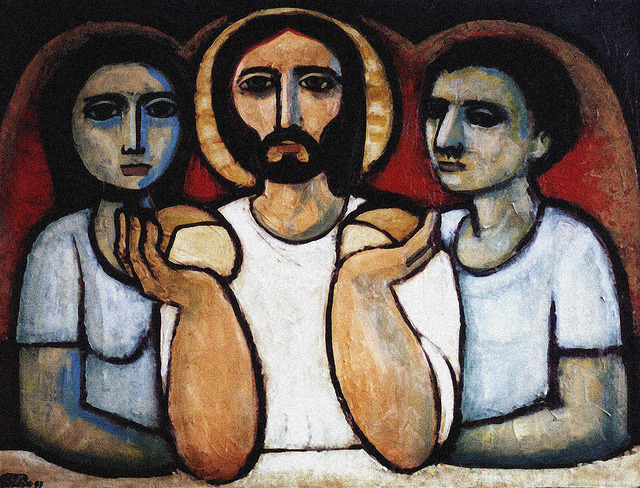
And Jesus lovingly listens to them describe the trauma of the crucifixion and their feelings of sadness and longing that were caused by His absence. He listens instinctively, as a way of being present and ministering to the disciples. To move from this great absence towards a new sense of presence, the disciples must emerge from their emptiness, to become open and receptive to new life. So, Jesus interprets scripture to prepare them to receive the good news of His Resurrection Presence.
I find the word “presence” to have great strength in it. It is what I wish and pray for whenever I am facing overwhelming grief or crucial conversations, and it is what I want for my friends in similar situations. In my experience, what keeps me from being truly present with another person is usually fear, avoidance, self-absorption, pain or some combination of those conditions. Here, Jesus models selfless presence, teaching us a way of moving from a personal experience of absence and longing toward the presence that can be found with God and in community.
Recognizing Jesus
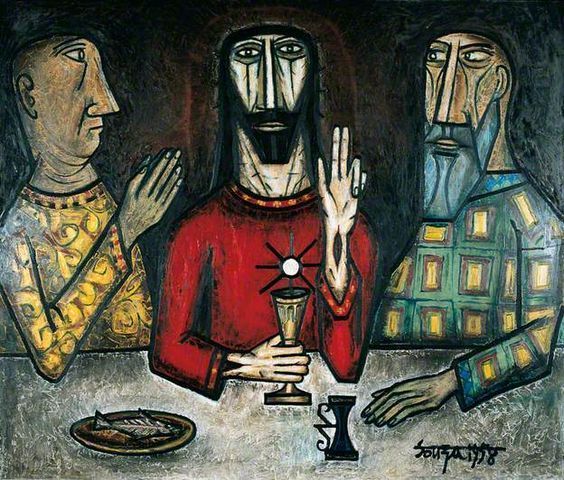
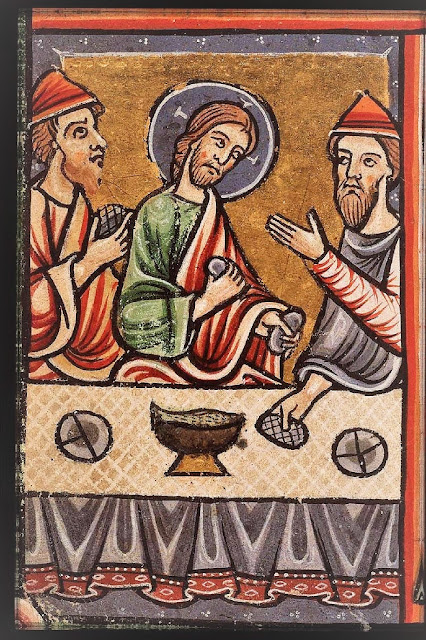
28 As they came near the village to which they were going, he walked ahead as if he were going on. 29 But they urged him strongly, saying, “Stay with us, because it is almost evening and the day is now nearly over.” So he went in to stay with them. 30 When he was at the table with them, he took bread, blessed and broke it, and gave it to them. 31 Then their eyes were opened, and they recognized him; and he vanished from their sight. (Luke 24:28-31)
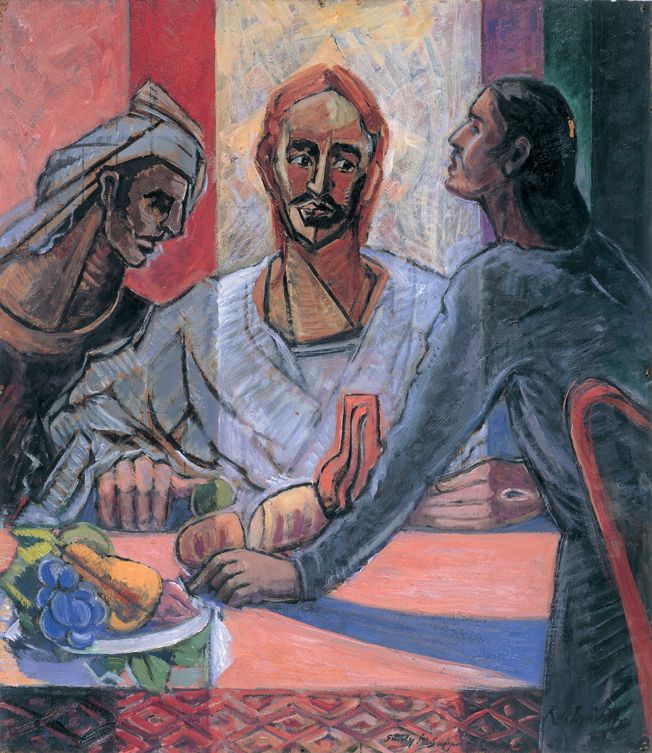
The turning point of the Emmaus story is when the disciples recognize Jesus in the breaking of the bread. This is so dramatic, because they came to an ultimate inner knowing of Divine presence during a simple meal of bread in a shared encounter of hospitality. In this high point of the resurrection account, the inner eyes of the disciples are opened, and they now view Jesus in a new way.
A crucial element of this consequential recognition takes place when Jesus takes, blesses, breaks, and gives the bread to the two disciples. It is a moment of eucharistic knowing that changes them forever. We’ve all had that experience of not being able to find something we are looking for and then suddenly it is right there. In a similar way, Cleopas and his friend were now able to see what had been right in front of them all along. Then, once His presence is felt, Jesus vanishes from sight.
Returning to Jerusalem
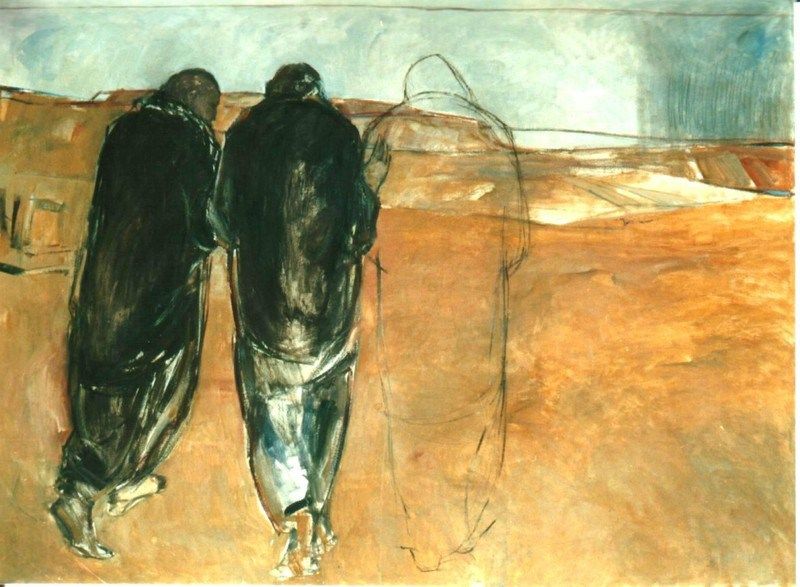
32 They said to each other, “Were not our hearts burning within us while he was talking to us on the road, while he was opening the scriptures to us?” 33 That same hour they got up and returned to Jerusalem; and they found the eleven and their companions gathered together. 34 They were saying, “The Lord has risen indeed, and he has appeared to Simon!” 35 Then they told what had happened on the road, and how he had been made known to them in the breaking of the bread. (Luke 24:32-36)
As soon as the two disciples recognized the presence of Jesus, they got up and rushed back to Jerusalem to share the news with their friends. Their response is immediate and without reservations. After a long day, they were still willing to make the seven-mile walk back to Jerusalem, which was perhaps even a dangerous journey after dark. Being in the presence of Jesus was so powerful that they went back eagerly, in order to share their story and joy with the other disciples.
Their original journey to Jerusalem for the Passover, their return home to Emmaus, and after recognizing Jesus, their journey back to the other disciples in Jerusalem are all part of a single, overarching physical, emotional, and psychological odyssey. Their movement from absence into presence was truly transformative, and they were no longer the same. They marveled at the encounter, saying, “Were not our hearts burning within us while he was talking to us on the road, while he was opening the scriptures to us?”
Summary
There are two main takeaways for me related to the Emmaus story. First of all, the emotions of loss and spiritual absence that touched the disciples echo the times when we feel lost and cannot feel the presence of God. Cleopas and his friend move from a sense spiritual absence to a profound experience of the presence of Jesus. And so, we are also called to recognize Christ who comes to us in resurrected form. This story reminds us that the risen Jesus is continually walking with us through life, even when we don’t recognize Him.
And the second lesson is that, when we are truly present with others who are in the midst of grief and loss, when we empathize with their situation and honestly open our hearts to them, we can channel the sacred presence of Jesus. And this actually changes us into the living body of Christ and His transformative love. Our hearts are on fire with the Holy Spirit, who gives us the courage to walk our journey, perhaps even stretching us in ways that we had never thought of before.
The gospel reading today, Luke 24:13-36, tells us a story of how Jesus meets us and becomes known to us in the breaking of the bread. May our eyes be opened, so that we can recognize Jesus among us. May our ears be opened, so that we can hear the small still voice of Wisdom. May our hearts within burn with hope and joy as we walk our own journeys with Christ. And may we always seek to move from absence and longing to a place of presence with family, friends, and neighbors, in such a way that we are transformed by these sacred moments. AMEN +++
Readings: New Standard Revised Version.
Reference 1: Marg Mowczko, Jesus Had Many Women Followers – Many!, blog post, March 14, 2014.
Reference 2: Victoria Emily Jones, The Unnamed Emmaus Disciple: Mary, wife of Cleopas? Blog post at Art & Theology website, April 28, 2017.
Reference 3: Michael Bayly, Good News on the Road to Emmaus, blog post at The Wild Reed website, April 13, 2013.
Reference 4: “The Road to Emmaus – Luke 24:13-35,“ commentary by National Catholic Education Commission.
Reference 5: Margaret Duffy, “Iconography of the Resurrection – Emmaus – The Journey,” blog post at Ad Imaginem Dei website, May 7, 2011.
Reference 6: Margaret Duffy, “Iconography of the Resurrection – Emmaus – The Recognition,” blog post at Ad Imaginem Dei website, May 7, 2011.
Image 1: Journey to Emmaus, French, First quarter of the 16th Century, Paris, Musée du Louvre.
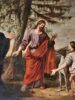
Image 2: Jesus at Emmaus, Arabic manuscript from 1684, Walters Art Museum, Baltimore, Maryland.
Image 3: Paige Payne, Did Not Our Hearts Burn Inside Us?
Image 4: Attributed to Pieter Coecke van Aelst, Journey to Emmaus, Flemish, circa 1530-1540, Private Collection.
Image 5: Eastern Tradition Icon of Road to Emmaus, “The Message of the Icon,” blog post by Robert Wreisner at Inside the Vatican Magazine, April 1, 2016.
Image 6: Maximino Cerezo Barredo (Spanish, 1932–), Supper at Emmaus. Acrylic on board, dining room of the Claretian Community, Maranga, Lima, Peru.
Image 7: Francis Newton Souza, “Supper at Emmaus with the Believer and the Skeptic,” https://globalworship.tumblr.com/post/142159343095/emmaus-art-india.
Image 8: Janet Brooks-Gerloff (1947-2008), Emmaus Road, German, 1992.
Image 9: Christ at Emmaus, French, from A Picture Bible, The Hague, Koninklijk Bibliotheek, MS KB 76 F 5, fol. 22v, circa 1190-1200 CE.
Image 10: Roy de Maistre, Australian, Supper at Emmaus, Methodist Modern Art Collection, MCMAC: 013, 1958.








Leave a Reply
Join the conversation by submitting a comment to this blog post below.