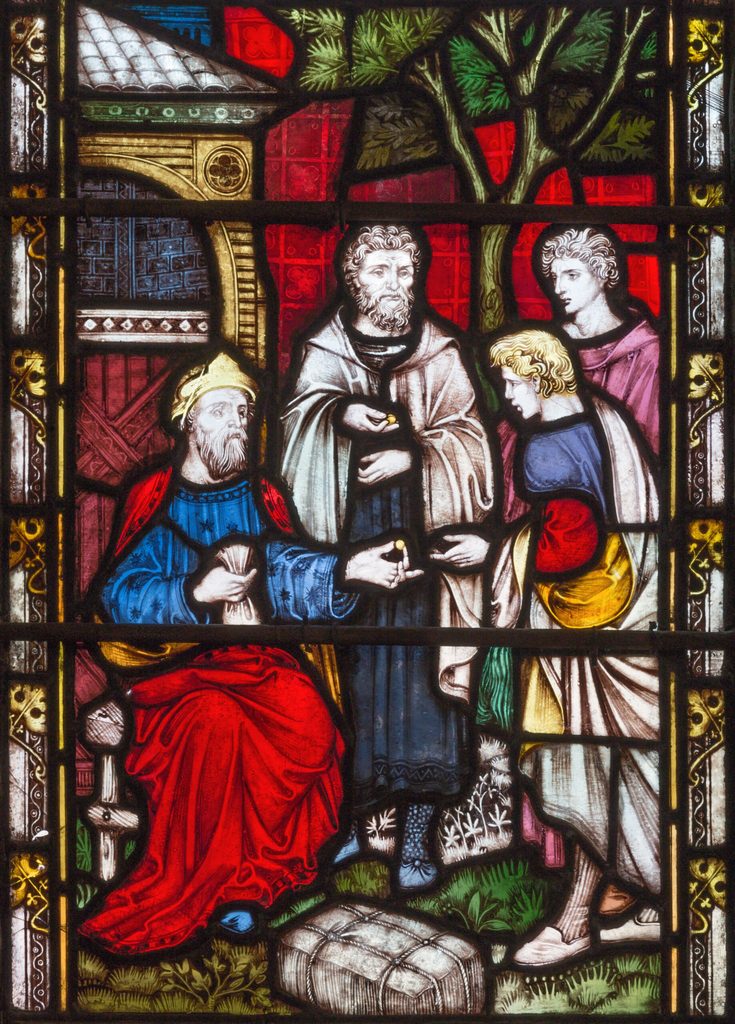
Our gospel today, the Parable of the Talents, is part of a discourse that Jesus delivered at the Mount of Olives. It is a series of three teachings about being ready for the coming of the Reign of God. This gospel was written about 50 to 70 years after the death and resurrection of Jesus, and Matthew was writing to an audience of Christians who were trying to figure out how to live their lives, as they waited for Jesus to return. The Parable of the Talents immediately follows the related story about spiritual vigilance that we read last week, the Parable of the Wise and Foolish Bridesmaids, where the wise women were prepared with extra oil. They trimmed their lamps and were greeted by the bridegroom opening the door to the banquet.
According to the Parable of the Talents, a “master” is going on a journey and entrusts his slaves, who in some translations are called servants, with his entire wealth. The first slave received five talents, the second received two talents, and the third received one talent, according to their abilities. We do not know how long the master was planning to be gone but, at least in this account, he did not seem to give any explicit instructions to the slaves.
For [the Reign of God] is as if a man, going on a journey, summoned his slaves and entrusted his property to them; to one he gave five talents, to another two, to another one, to each according to his ability. Then he went away. At once, the one who had received the five talents went off and traded with them and made five more talents. In the same way, the one who had the two talents made two more talents. But the one who had received the one talent went off and dug a hole in the ground and hid his master’s money. (Matthew 25:14-18)
One talent may sound like a small amount, but it was extremely valuable, in the time of Jesus. A single talent was worth around 6,000 denarii, where one denarius was the normal daily wage in Israel at the time. I’m not sure this can be extrapolated out to today exactly, but let’s do the math anyway. Using the numbers above, one talent would be worth about 16 years of standard labor. Now, if we use the sum of $40,000, which corresponds roughly to a year at Denver’s minimum wage of $19.00/hour in 2026, that means that the slave with five talents received $3.2 million dollars, the one with two talents received $1.28 million dollars, and the third slave, with one talent, received $640,000. So that’s a huge amount of money, over $5 million, to give to your slaves with no detailed instructions.
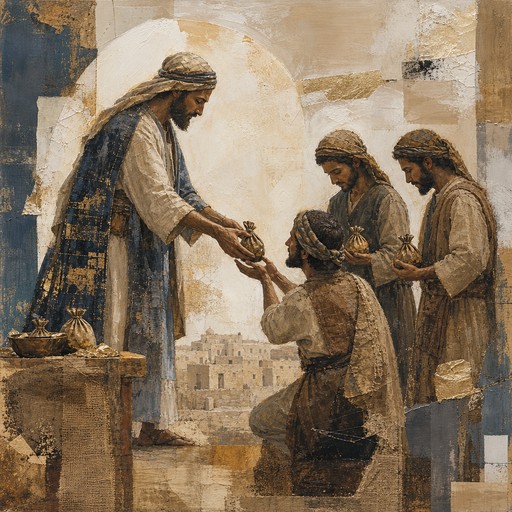
After a long time the master of those slaves came and settled accounts with them. Then the one who had received the five talents came forward, bringing five more talents, saying, “Master, you handed over to me five talents; see, I have made five more talents.” His master said to him, “Well done, good and trustworthy slave; you have been trustworthy in a few things; I will put you in charge of many things; enter into the joy of your master.” And the one with the two talents also came forward, saying, “Master, you handed over to me two talents; see, I have made two more talents.” His master said to him, “Well done, good and trustworthy slave; you have been trustworthy in a few things; I will put you in charge of many things; enter into the joy of your master.” (Matthew 25: 19-23)
The first two slaves proceeded to take risks with the money and ended up doubling their talents, together bringing in a profit of $4,480,000. When the first two slaves settled accounts with the master, they were given word for word, identical praise for the money they had made, along with the promise of more responsibility in the future.
Then the one who had received the one talent also came forward, saying, “Master, I knew that you were a harsh man, reaping where you did not sow and gathering where you did not scatter, so I was afraid, and I went and hid your talent in the ground. Here you have what is yours.” But his master replied, “You wicked and lazy slave! You knew, did you, that I reap where I did not sow and gather where I did not scatter? Then you ought to have invested my money with the bankers, and on my return I would have received what was my own with interest. So take the talent from him, and give it to the one with the ten talents. For to all those who have, more will be given, and they will have an abundance, but from those who have nothing, even what they have will be taken away. As for this worthless slave, throw him into the outer darkness, where there will be weeping and gnashing of teeth.” (Matthew 25: 23-30)
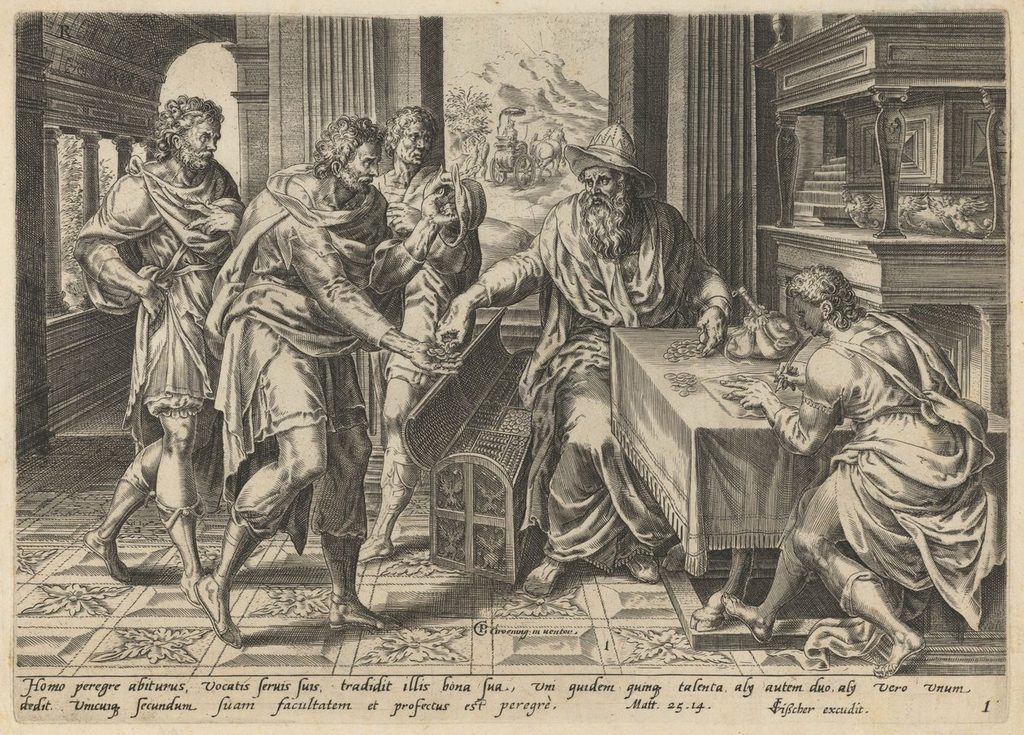
But things were different for the third slave, who had buried the fortune entrusted to him, to be sure none of it was lost. Remember the third slave had the least abilities. In Luke 12:48, we hear that to those who are given more, more is required. However, this master apparently expected the same from all of his slaves, even the one who was not as smart or industrious or sneaky as the other two slaves who risked everything.
We are told that this third slave buries the talent out of fear, because the master is a harsh man who “reaps what he does not sow and gathers where he has not scattered seed.” It seems that the greedy master is known for aggressively expanding his estate by taking whatever he can, wherever he can, to make a profit, and he does not deny this characterization. Rather, he reprimands the third slave for failing to invest the talent with bankers so that it would at least gain interest, which notably is a practice forbidden by Jewish law at the time (Exodus 22:25; Leviticus 25:35-38).
Many of the people listening to Jesus believed that resources were limited, so if some people were wealthy and had many worldly goods, then it meant that others were being deprived or exploited. Honorable Jewish people would try to avoid looking greedy at the expense of others by having their slaves handle their financial transactions. Such behavior, including getting around the law against charging interest, was acceptable for slaves, because everyone knew that slaves were not honorable anyway. So, it is possible that this master gives his money to his slaves to invest, because that’s what rich people do to sidestep the Torah and to avoid getting their own hands dirty.
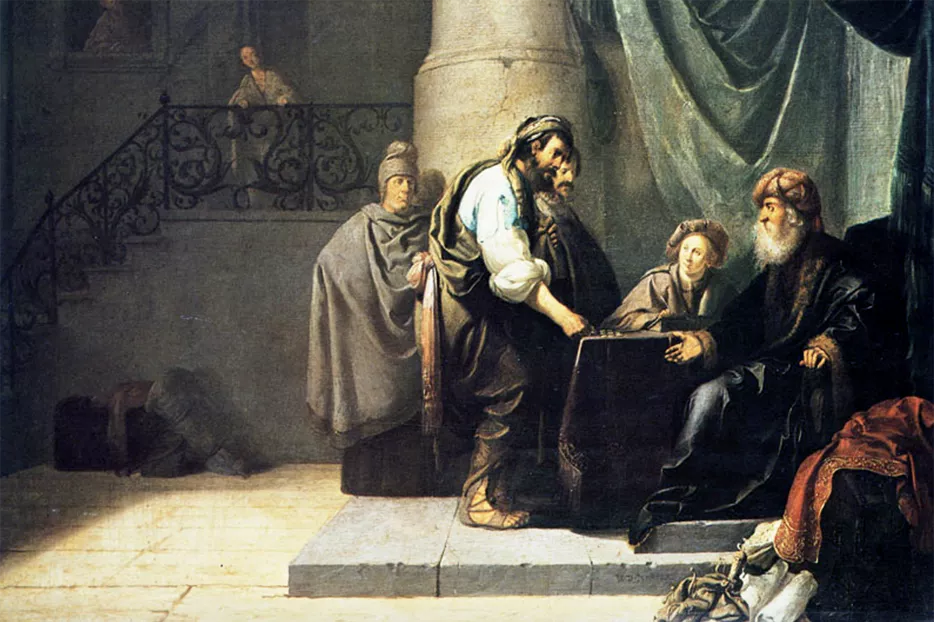
One commentary I read said that the issue is not that the third slave had less than the others but that he misunderstood the master and responded with fear, passivity and distrust. I don’t think the third slave misunderstood—he seems to have been paying attention to his master and had a clear picture of him. But it does say that he buried the talent because he was afraid. And it is true that fear often operates in such a way that it paralyzes us! Instead of acting, the third slave was boxed in by the mindset of self-preservation.
Here is where, in my mind, this challenging parable goes a little bit offroad. The master takes the talent from the third slave and gives it to the first slave, the one with the most money. The gospel reads, “For to all those who have, more will be given, and they will have an abundance, but from those who have nothing, even what they have will be taken away.“
Wait—what? Not surprisingly, this is one of the Bible verses that is used to support the prosperity gospel that exists in parts of evangelical Christianity. Supposedly, if you are a good person, your wealth will continue to increase, and it becomes a sign of favor and divine grace. But woe to the poor! They must be unfaithful disciples. In this story, the third slave, the one who played it safe, is thrown dramatically “into the outer darkness, where there will be weeping and gnashing of teeth.“
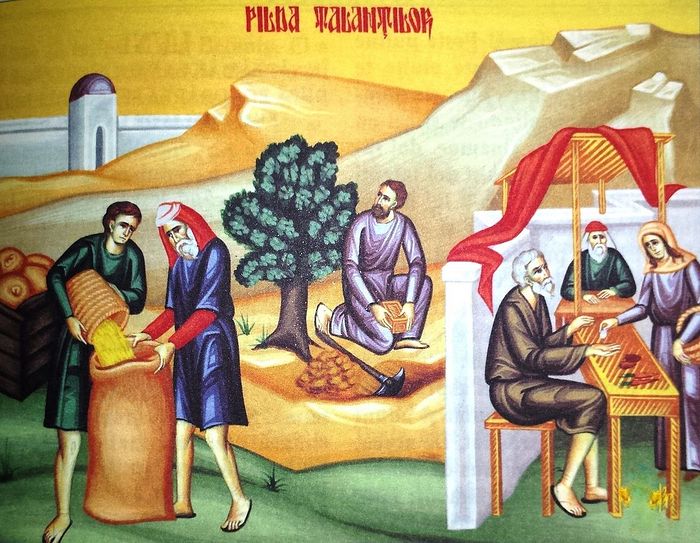
Actually, this sounds a lot like our current conditions—how the rich billionaire class is getting richer and the poorest are getting even poorer. It happens here in the US, where our political and economic systems ensure that income inequality gets perpetuated. And it happens across the globe, where people in developing countries are impoverished, and rich countries prosper at their expense. There are just too many people who are casualties of war, who are starving to death or dying from horrific diseases. There are people who lack safe drinking water or any water at all, who are bearing the brunt of climate change, those with no hope of escaping their desperate situations and “the outer darkness” of their poverty.
So, here is where I spent a lot of time reading and struggling with this parable. It seems like on the surface, the Parable of the Talents can be interpreted as an apocalyptic teaching about how to prepare for the Judgement Day, when we must defend what we have done with what we have been given to God. I struggled because, if the harsh and greedy master in the story is supposed to be God, then that doesn’t sound like the God who elsewhere tells us that the first will be last and the last will be first, if you ask me. And this does not sound like the God who loves us more than we can know or imagine. But I read that parables are like puzzles or “little gymnasiums for thinking,” not strict allegories where each character stands for someone in a straightforward way. So in the end, there’s no one correct way of interpreting a parable.
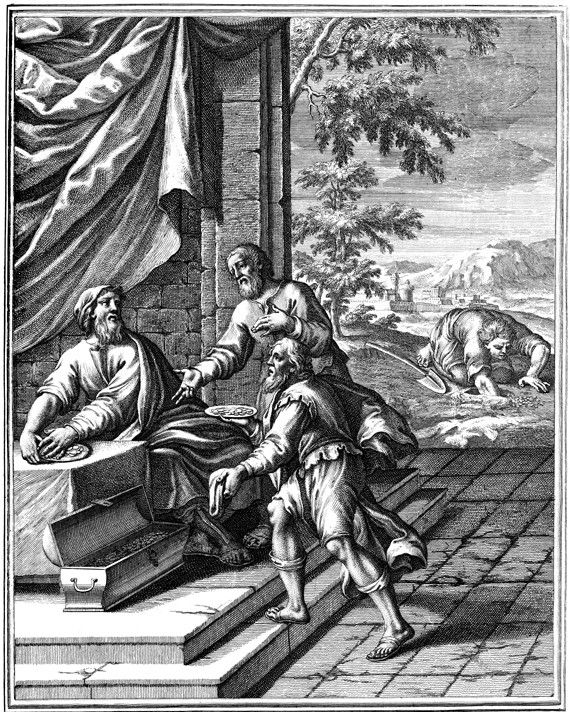
The traditional take on this gospel is, for us as English speakers, to recognize the play on words with the word “talent.” The point is that we are all given gifts and talents by God that we are responsible for developing and using wisely. All that we have—our time, opportunities, abilities, relationships, resources, and skills—are entrusted to us by God. This story encourages us to use these gifts that we have been given, instead of burying them out of fear. This is a solid interpretation, and it recognizes that we are called not only to preserve what we’ve been given, but to actively work to share these gifts in service to others.
The Parable of the Talents is more than a lesson in earning salvation or proving spiritual worth. It’s not about improving our talents or working harder all the time. This parable is a reminder that fear can paralyze our spiritual growth. In this way, the Parable of Talents fits into a larger context about spiritual vigilance, like the wise and faithful bridesmaids from last week’s gospel reading.
Being faithful is an active state, and the story challenges us to act boldly. Therefore, it seems to me that maybe this parable is all about risk and fear.
Portia Nelson writes the following about risk and fear:
I was always afraid of risking risk. But I found that I could stand to risk risk better than I could stand to fear fear. At least, risking brought about changes… and the changes took up so much time, I forgot what it was I was afraid to risk losing… in the first place.
Portia Nelson (1977)
Fear can definitely paralyze us and keep us from being our best selves, but stepping up and taking a risk is important. So how can we gain the courage to move forward against fear and toward love? We need to remember that God is bigger than our deepest fears and we must continue to do what each of us has the unique power to do. We must breathe deeply of Wisdom/Sophia/Spirit who lives within us and dare to be all that we are created to be. We are challenged to daring action—not reckless or thrill-seeking daring, but rather boldness that is wise and grounded and generative.
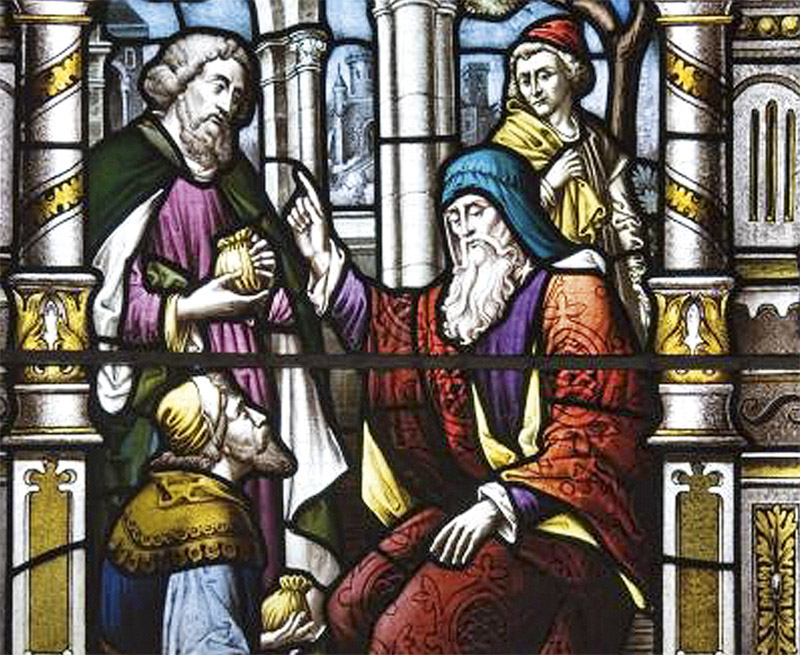
I love this poem by Nicola Slee that I included in my book, Women Give Voice to Wisdom: Praying Lectio-Visio Divina:
Dare to declare who you are. It isn’t far from the shores of silence to the boundaries of speech. The road is not long but the way is deep. And you must not only walk there, you must be prepared to leap.
Nicola Slee (2004)
Being prepared to leap means trusting God and being open to taking risks. In order to be disciples of Jesus, we cannot play it safe or take the easy way out. We must risk. We must risk reaching out to other people. We must risk standing up against bullies. We must risk failure. We must risk speaking up for our values. We must risk giving voice to the marginalized, who are voiceless. We must risk being uncomfortable talking to someone who is homeless. We must risk changing when we need to. We must risk asking for help. We must risk being vulnerable in crucial conversations with family members and our closest friends. So, I guess at the end of this reflection, the question I want to leave you with is this—what are you willing to risk for the sake of Jesus and the Gospel?
Reading: Matthew 25:14-30, New Revised Standard Version (Updated Edition).
Reference 1: Reverend Dawn Hutchings, For Christ’s Sake! It’s Not About God! – a sermon on the Parable of the Talents, Matthew 25: 14-30, November 14, 2017.
Reference 2: SALT, Be Daring, Salt’s Commentary for Twenty-fifth Sunday After Pentecost, November 9, 2026.
Reference 3: Carla Works, Commentary on Matthew 25:14-30, workingpreacher.org, November 19, 2023.
Reference 4: Greg Carey, Commentary on Matthew 25:14-30, workingpreacher.org, November 16, 2014.
Reference 5: Clay Gentry, A Comparison of the Parable of the Talents and the Parable of the Minas, September 3, 2013.
Reference 6: Brendon Manson, Matthew 25:14-30 Meaning: The Parable of the Talents Explained, Fellowship Development website, June 30, 2026.
Reference 7: Portia Nelson, There’s a Hole in My Sidewalk: The Romance of Self-Discovery, Atria, New York, 2012, p. 102.
Reference 8: Nicola Slee, Praying Like a Woman, Society for Promoting Christian Knowledge, London, Great Britain, 2004.
Image 1: Stained glass depiction of the Parable of the Talents in St Mary Abbot’s church on Kensington High Street, London, September 19, 2017.
Image 2: Artist unknown, Parable of the Talents, Bible Art website, accessed September 20, 2026.
Image 3: Lucas van Doetecum, The Parable of the Talents, Flemish engraving, circa 1560, MeisterDrucke website, accessed September 18, 2026.
Image 4: Willem de Poorter (1608-circa 1649), The Parable of the Talents or Minas, 17th century Flemish painting.
Image 5: The Parable of the Talents, Byzantine Style, Orthodox Christianity, September 19, 2018.
Image 6: Artist unknown, Parable of Talents woodcut from Historiae celebriores Veteris Testamenti Iconibus representatae, circa 1712, Wikimedia Commons, public domain.
Image 7: Stained glass depiction of the Parable of the Talents, Victoria Road Church, Newport, Wales, Photograph by Divulgation, published in the Heralds of the Gospel Magazine, accessed November 15, 2026.












Leave a Reply
Join the conversation by submitting a comment to this blog post below.