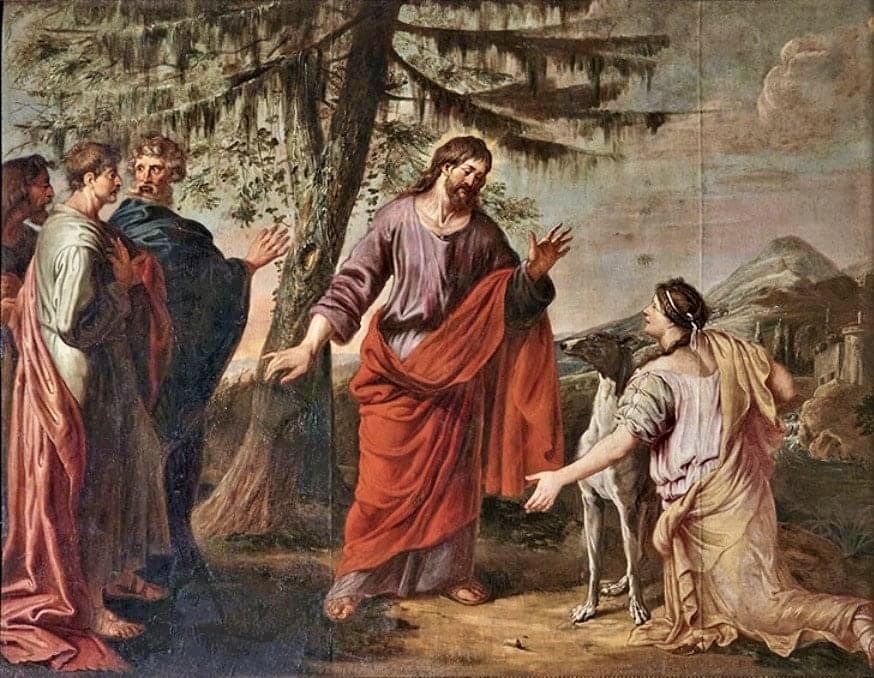
One thing you can say about Jesus is that He treats the women He meets as worthy and autonomous human beings. He affirms and uplifts women and always seems to be going out of His way to talk to them. He believes women have the same capacity to accept and understand the significance of His teachings that men do. He encouraged women to interact with Him and to personally respond to His religious and social teachings. Among others, we see this in the stories of the hemorrhaging woman (Mark 5:25-34) and the woman at the well (John 4:1-26, 39-42), who were two other unnamed women in the gospels.
The gospel story this morning is about the Canaanite woman and how she extended the table of the Lord. It is one of my favorite accounts of Jesus interacting with women, during His ministry. I love it so much because she uses her perseverance to petition Jesus repeatedly, until He finally recognizes her faith and heals her daughter.

I’ve been seriously persistent all my life, so this Bible reading really resonates with me. For example, I started a cross-stitch project when I was twelve and finally finished it maybe about fifteen years later, not long after I completed graduate school. Also, I spent I don’t know how many hours building my website by watching YouTube videos over and over and over and following the instructions. It took me ten years altogether, but I refused to give up and finally published my book, Women Give Voice to Wisdom: Praying Lectio-Visio Divina, last year. So, the Canaanite woman who persevered with Jesus is, in my eyes and ears, the hero of this story.
This blog post breaks open the story of the Canaanite woman who caused Jesus (who was not too proud to admit He was wrong) to change His mind about the scope of His mission. It is also recounted as the story of the Syrophoenician woman in Mark 7:24-30.
Jesus left there and departed for the district of Tyre and Sidon. It happened that a Canaanite woman living in that area came out and cried to Jesus, “Son of David, have mercy on me! My daughter is horribly demon-possessed.” Jesus gave her no word of response.
The disciples came up and repeatedly said to him, “Please get rid of her! She keeps calling after us.” Finally, Jesus turned to the woman and said, “My mission is only to the lost sheep of the House of Israel.”
She then prostrated herself before him with the plea, “Help me, Rabbi!” He answered, “But it isn’t right to take the children’s food and throw it to the dogs,” “True, Rabbi,” she replied, “but even the dogs get to eat the scraps that fall from the table.”
Jesus then said in reply, “Woman, you have great faith! Your wish will come to pass.” At that very moment, her daughter was healed. (Matthew 15:21-28)
This story begins either in the region of Tyre and Sidon itself or close to it, on the way. In either case, we are told that the Canaanite woman “comes out” to meet Jesus in an area of borderlands where many Gentiles were living. In this threshold space at the margins, at a time when Jews considered Gentiles to be unclean–people to be rigorously avoided–this Canaanite woman made her disturbing presence known. She came out of nowhere to Jesus, shouting at him, “Son of David! Kyrie eleison–have mercy on me!” As she asks for healing for her daughter, how does Jesus initially respond? He just ignores her entirely. “Can’t see you–talk to the hand.” Maybe, in some way, she just blends into her surroundings and does not even exist for Him.
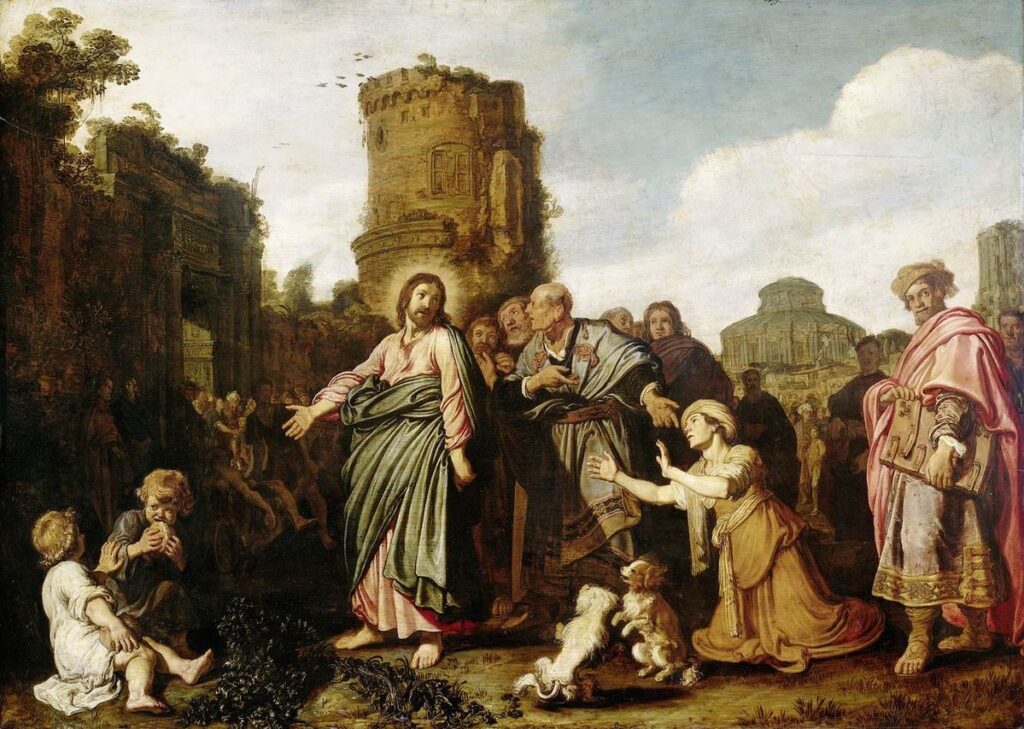
Here is the situation for the Canaanite woman. She is obviously desperate, because her daughter has become possessed by demons (could be epilepsy, could be autism, could be mental illness, could be demons I guess). She knows she has no right to ask anything of Jesus–that He does not owe her anything. She is not a Jew or a disciple–she is not promising to devote herself to Him. She offers no money for His ministry, but here she is, asking Him for everything.
So Jesus, in His first response to the three verbal exchanges, does not even acknowledge her presence. He acts as if she does not exist at all. As usual, His disciples are dismissive and urge Him to send her away. Jesus replies to them by basically affirming that His ministry is for His Jewish friends only–the lost sheep of the House of Israel. But yet, this persistent, unnamed woman still refuses to leave. She is bold and presumptuous, making no apologies for herself. Begging for the life of her daughter, she recognizes her diminished status but still is confident that the love of God is not restricted just to the chosen people.

As she keeps up the pressure, Jesus responds the third time with what appears to be a racial slur. He tells the Canaanite woman that it is not right to throw the food of children to dogs. He was comparing her and her daughter to dogs. But this quick-witted, faith-filled, clever woman comes back with the observation that even the dogs can get scraps under the table. She takes His image and turns the insult around by saying that even dogs are fed. In this way, she is not a passive recipient of grace but actively participates in her own salvation. As Anne Thurston writes, “words of exclusion are subverted, until they become the principle of inclusion.” She refuses to be minimized by her race and gender or to be dismissed as simply an annoying and disturbing outsider. Instead, the Canaanite woman does not hesitate to speak up, effectively interrupting and opening up the mission of Jesus.
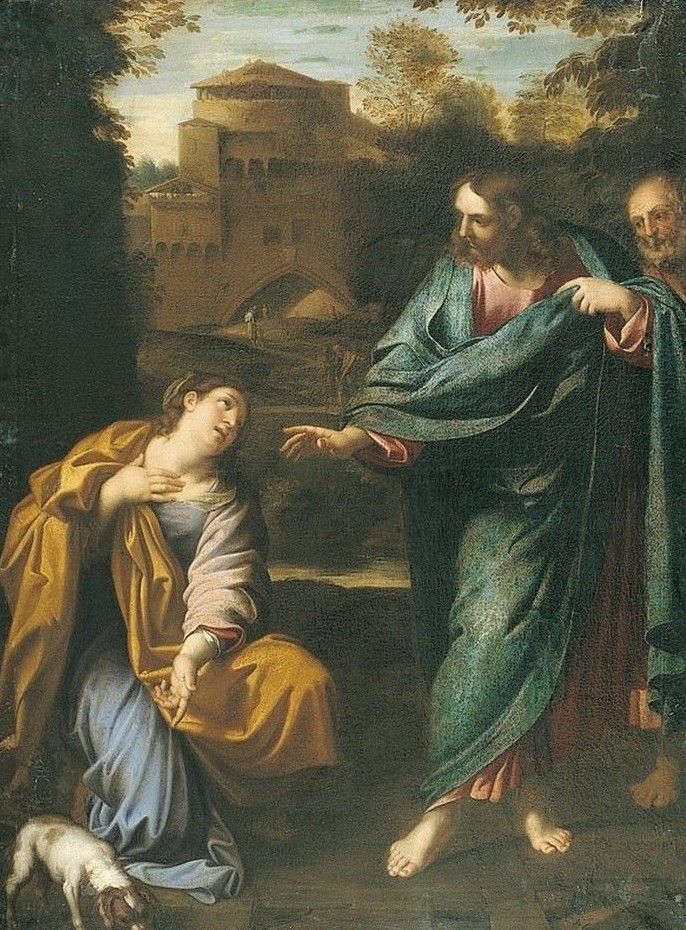
Finally, here at this turning point of the story, Jesus capitulates and praises her great faith in God. This contrasts with the gospel last week where Jesus chastised the faith of Peter, who began to sink while he was walking across the water. But today’s gospel reading also becomes a story about breaking boundaries and a paradigm shift in perspective. We often think of the woman as being humble, since she was at the feet of Jesus petitioning for her daughter. However, it is actually Jesus who models humility, because He can admit that He was wrong, that He had drawn the boundaries around His ministry too tightly.
Here, the discussion of healing quickly turned to the question of food. Jesus becomes open to extending His table to Gentiles as well as to His Jewish community. In this way, exclusiveness no longer has the last word. And this was all because the unnamed Canaanite woman dug deep for courage and did what she had the power to do. And in doing so, she gains respect for herself as well as healing for her daughter. Here, Jesus is not initially acting on compassion for the woman (he ignores then insults her), but rather He comes to recognize the need for justice to be done.
We should not read this story as saying that, if we aren’t being healed of an affliction or relieved from a particular situation, that means we aren’t faithful enough. And we should not read this story as Jesus was somehow testing the faith of the woman by ignoring and then insulting her. What we should do is recognize that this story is situated between the feeding of the 5000 in Jewish-centric territory (Matthew 14:13-21) and the feeding of the 4000 in the borderlands of Gentile territory (Matthew 15:32-39). This changes our way of looking at the story of the unnamed woman, so that it revolves around questions of table fellowship. Here, in the feeding of the 4000, we see Jesus following through on the extension of His table to the Gentiles.
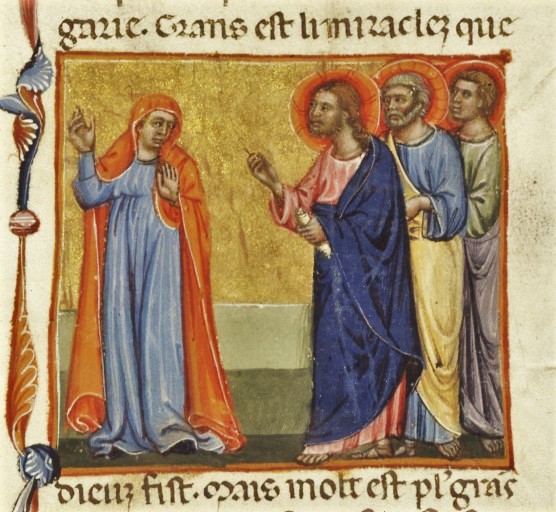
God has always been, and will always be, a God of compassion, inclusion, and justice. Everyone is welcome at God’s table. So, today, I am praying that we may all exhibit the faith and courage of the Canaanite woman, who pushed her way into the presence of Jesus to ask for healing for her daughter. May we always persevere in compassion, inclusion and justice, as we find ways to do what we each uniquely have the power to do!
Reading: Matthew 15:21-28, lightly edited, The Inclusive New Testament, Priests for Equality, Brentwood, MD, 1994.
Reference 1: Helen Bruch Pearson, Do What You Have the Power to Do: Studies of Six New Testament Women, Upper Room Books, Nashville, TN, 1992, pp. 75-93.
Reference 2: Anne Thurston, Knowing Her Place: Gender and the Gospels, Paulist Press, New York, 1998, pp. 25-32.
Reference 3: Margaret Duffy, Illustrating Miracles: The Canaanite Woman, blog post at Ad Imaginem Dei website, August 17, 2014.
Image 1: Michael Angelo Immenraet, The Woman of Canaan, 17th century, Flemish, Wikimedia Commons, public domain.
Image 2: Ilyas Basim Khuri Bazzi Rahib, Jesus and the Canaanite Woman, Walters manuscript W 592, 1684 CE.
Image 3: Pieter Lastman, Christ and the Woman of Canaan, Dutch, 1617, Wikimedia Commons, public domain.
Image 4: Masters of Otto von Moerdrecht, Miracle of the Canaanite Woman from a Picture Bible, Dutch (Utrecht), circa 1430, The Hague, Koninklijke Bibliotheek, MS 78 D 38 II, fol.164v.
Image 5: Annibale Carracci, Christ and the Canaanite Woman, 1595, Wikimedia Commons, public domain.
Image 6: Miracle of the Canaanite Woman from Sermons of Maurice de Sully, Italian illuminated manuscript, circa 1320-1330, Paris, Bibliotheque nationale de France, MS Francais 187, fol. 9v.
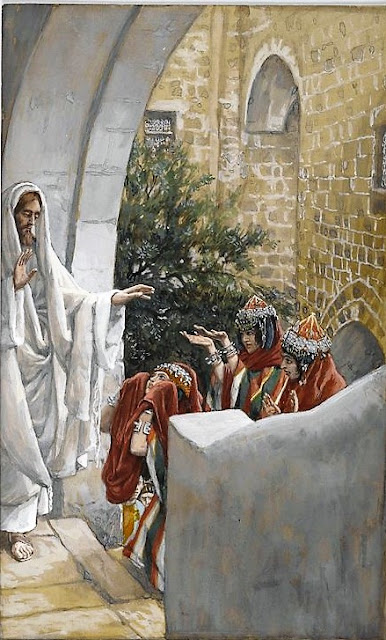
Image 7: James Tissot, Jesus and the Canaanite Woman, French, 1888-1894, New York, Brooklyn Museum.












#/media/File:Annibale_Carracci,_Cristo_e_la_Cananea,_1595,_Parma.jpg)
Leave a Reply
Join the conversation by submitting a comment to this blog post below.