Last updated October 23, 2025
Souling History
I’m a few days late, but I wanted to share with you a piece of what I have learned this year about the origin of Halloween and the tradition of something called soul cakes. Soul cakes, sometimes referred to as souls, are the precursor to Halloween trick or treating that dates to medieval England and Ireland.
Before the Christian era began, Druidic rites included the building of bonfires to banish the evil spirits thought to be lurking in the shadows. All Hallows Eve (Hallowe’en), known at the time as Samhain, was the festival of the dying sun god and the coming of the dark power of winter. In the Celtic traditions, Samhain was known as “Summer’s End” and coincided with a ceremonial third harvest, a time for gathering berries and nuts. However, most of our modern Halloween traditions likely date to Christianity in the Middle Ages rather than to Samhain celebrations. By 800 CE, feast days commemorating saints were celebrated throughout Europe, although they were not specifically created to replace pagan rituals. In fact, it seems that the All Saints Day feast was created in the 7th century by Pope Boniface IV, who converted the Roman Pantheon into a Christian church dedicated to saints and martyrs. By 1471, Allhallowtide became the word used to describe the Western Christian triduum of All Hallows Eve, All Saints Day (aka All Hallows or Hallowmas) and All Souls Day.
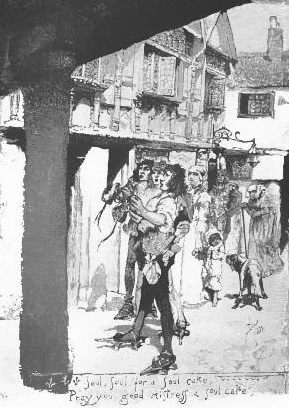
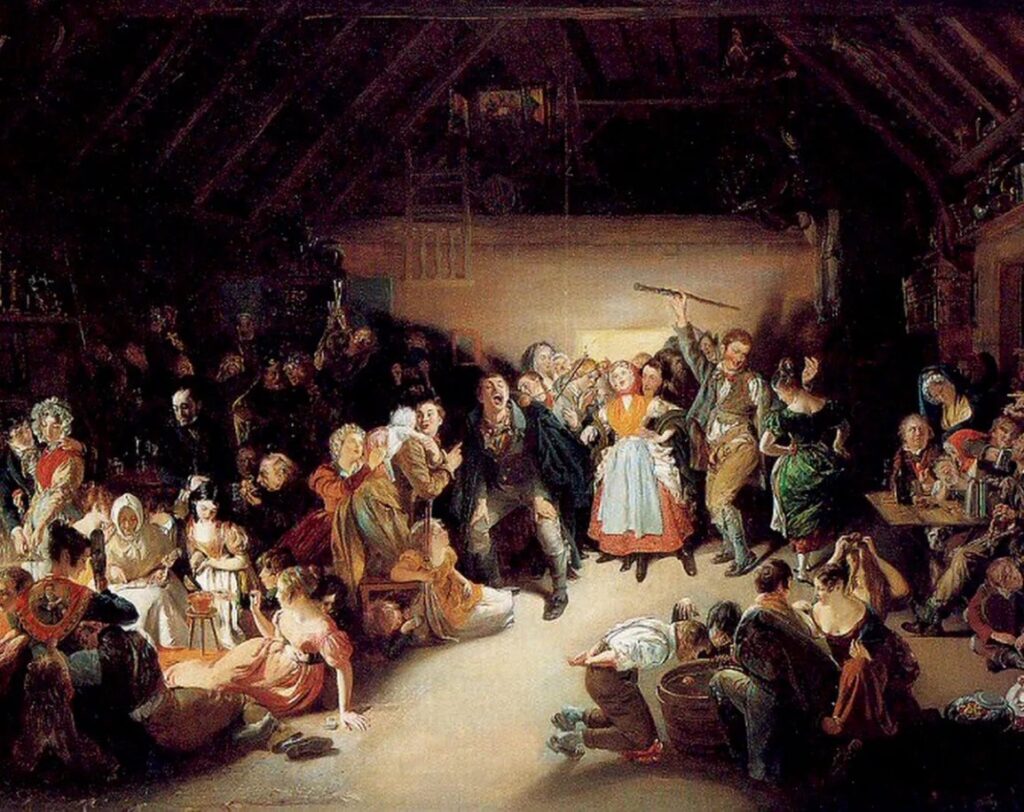
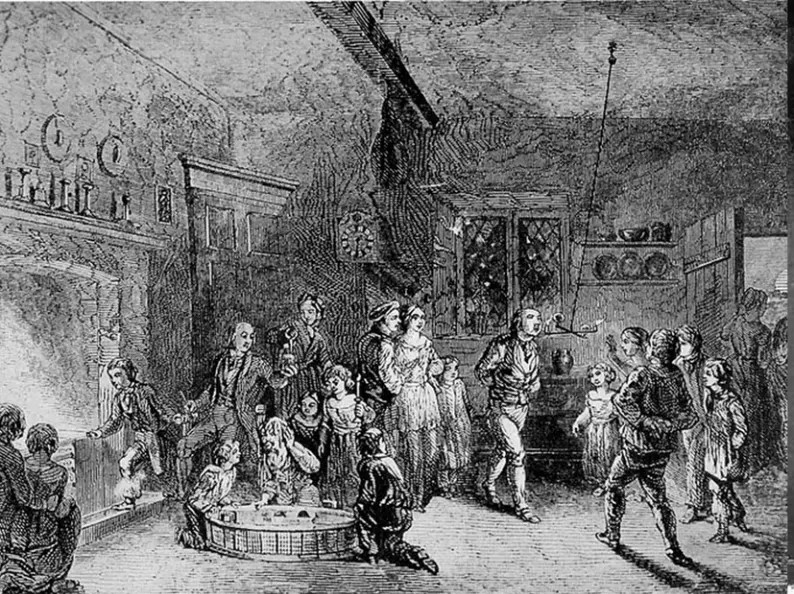
During Allhallowtide, soul cakes were set out with glasses of wine or ale as an offering for the dead. Then children and the poor, would visit farms and cottages going “souling” door-to-door, singing and asking for soul cakes in return for prayers for deceased household members. Every soul cake received was greeted with a prayer for one of the souls in purgatory, the intermediate state between Heaven and Earth. The earliest reference to souling dates back to 1589-1593, when Shakespeare mentioned “pulling like a beggar at Hallowmas” in his play The Two Gentlemen of Verona. Images 1-3 show depictions of Allhallowtide gatherings, where customs associated with souling included eating and/or distributing soul cakes, singing, bobbing for apples, carrying lanterns, dressing in disguise, bonfires, and playing divination games.
Souling Song Fragments
Some evidence of the songs that were sung on All Hallows Eve are still in existence. One of these songs is known as Soul Cake Song or Cheshire Souling Song, among other names. There are various versions of its music and lyrics, but you can listen to the earliest recorded version of it and download the sheet music at the Tradition in Action website (Reference 4 below). This 1891 version of the souling song was collected by nineteenth century folklorist Lucy Broadwood and contains the following chorus:
“A soul! A soul! A soul-cake! Please good Missis, a soul-cake! An apple, a pear, a plum, or a cherry. Any good thing to make us all merry. One for Peter, two for Paul. Three for Him who made us all.“
In addition, the following preserved fragment of lyrics has been attributed to John Aubrey from the 17th century:
“A soule cake, a soule cake, have mercy on all Christian soules for a soule cake.”
Soul Cake Recipes
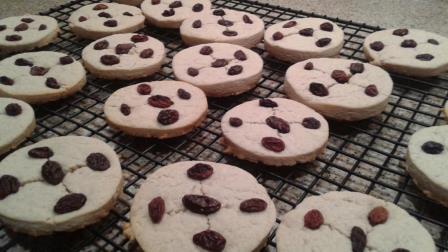
Soul cakes, also called soulmass or somas cakes, were small round pastries similar to shortbread biscuits, usually filled with spices such as nutmeg, ginger, all spice, or cinnamon, and were decorated with currants and the sign of the cross. According to Atkinson (1868), soul cakes were “sets of square farthing cakes with currants in the centre, commonly given by bakers to their customers.” They may have also been served at funerals. Soul cakes may have originated as cakes that were baked for the Samhain bonfires or, some say that they were tossed around the village in order to appease evil spirits that were condemned to wander the area in animal form. There was also an ancient tradition of taking small bread rolls as offerings to the deceased in the graveyards.
Here are two recipes I have tried–the first from back in 2017 when I originally wrote this blog post. You can see from the photo that I used raisins instead of currants. They were tasty, but really more of a super heavy, spiced cookie than a cake. Andy said, “They taste like fall.”
Recipe 1–TRADITIONAL SOUL-CAKES–Lavender and Lovage website
Ingredients:
- 175g butter (6oz)
- 175g caster sugar (6oz)
- 3 egg yolks
- 450g plain flour (10½ oz)
- 2 teaspoons mixed spices
- 100g currants (4oz)
- A little milk, to mix
Instructions: Preheat the oven to 375F. Cream the butter with the sugar until it’s light and fluffy and then beat in the egg yolks one at a time. Sift the flour into another bowl with the mixed spices and then add them to the wet mixture along with the currants (reserving a small handful to decorate the tops later.) Mix with a wooden spoon and then add enough milk to pull everything together into a dough. Roll out to a thickness of about 1cm and cut out rounds with a biscuit cutter. Use a straight-edged knife to make a slight cross indent in the top of each cake and then push in currents along it. Place on a piece of baking parchment on a baking tray and bake for 10-15 minutes or until golden brown. Cool on a wire rack and store in an airtight tin for up to 5 days.
Recipe 2–CRABAPPLE AND HAZELNUT ALL HALLOWS’ CAKES–Gather Victoria website
Ingredients:
- 2½ cups all-purpose flour
- 3 tbsp finely chopped crabapples (or tart apple)
- 2 tbsp chopped roasted hazelnuts
- 3 tbsp golden currants or raisins
- ¼ cup dark currants or raisins
- 1 tsp nutmeg
- 1tsp cinnamon
- 2 tsp minced ginger (fresh or candied)
- ½ tsp salt
- 4 tsp baking powder
- ½ cup sugar
- 2 egg yolks
- ½ cup milk (you may need more or less)
- 1 stick (8 tbsp) unsalted butter
- For the Caudle Glaze: 1 egg yolk, beaten, 1 tsp cream and ¼ cup granulated sugar
Instructions: Preheat the oven to 400ºF. Line two baking pans with parchment paper. In a large bowl, combine the flour, sugar, salt, baking powder, nutmeg, cinnamon, and ginger. Mix well with a fork. Add the cubed butter and cut with a pastry cutter or a fork until the butter is the size of large peas. Add the egg yolks one at a time, blending with the back of a spoon. Add golden currants, crabapples, hazelnuts, and dark currants (save a handful for decorating the tops of your cakes). Then, one tablespoon at a time, begin adding in the milk, blending until a soft dough begins to form. You may not need all of your milk. Turn the dough out onto a floured counter and knead gently a few times. Without over-kneading, roll out gently to a thickness of 1 inch. Using a 2-inch round cookie- or biscuit cutter, cut out your rounds and set on your baking sheets. Beat together the egg yolk and cream, and brush this mixture over the tops of the cakes. Sprinkle generously with sugar and decorate with the remaining black currants. Bake for 15 to 20 minutes, until golden and shiny.
UPDATE: This blog post was significantly overhauled on October 23, 2025 to verify links, to include many more details about souling, and to add two more images and a second recipe for soul cakes.
Reference 1: Soul Cakes: Hallowed Offerings for Hungry Ghosts, Susan Chang, National Public Radio, October 24, 2007.
Reference 2: “Soul Cakes” for an Old-Fashioned All Hallows Eve, Danielle Prohom Olson, Gather Victoria website, October 29, 2019.
Reference 3: Saturday Bakes & Cakes: All Soul’s Day and a Traditional Soul-Cakes Recipe, Karen Burns-Booth, Lavender and Lovage website, November 2, 2013.
Reference 4: Soul Cake Song: British All Soul’s Day Song, Tradition in Action website, accessed October 15, 2025, https://www.traditioninaction.org.
Reference 5: Barr, Beth Allison, Halloween: More Christian than Pagan, Patheos, October 31, 2015.
Image 1: Souling on Halloween, Wikimedia Commons, originally published in “St. Nicholas: An Illustrated Magazine for Young Folks”, Scribner & Company, December 1882, p. 93, public domain.
Image 2: Snap-Apple Night by Irish artist Daniel Maclise, created in 1833.
Image 3: Unknown Artist, Book of Hallowe’en by Ruth Edna Kelley, 1919, Wikimedia Commons, public domain.
Image 4: Soul Cakes, photo by Julie Henkener, October 2017.
Image 5:









Leave a Reply
Join the conversation by submitting a comment to this blog post below.