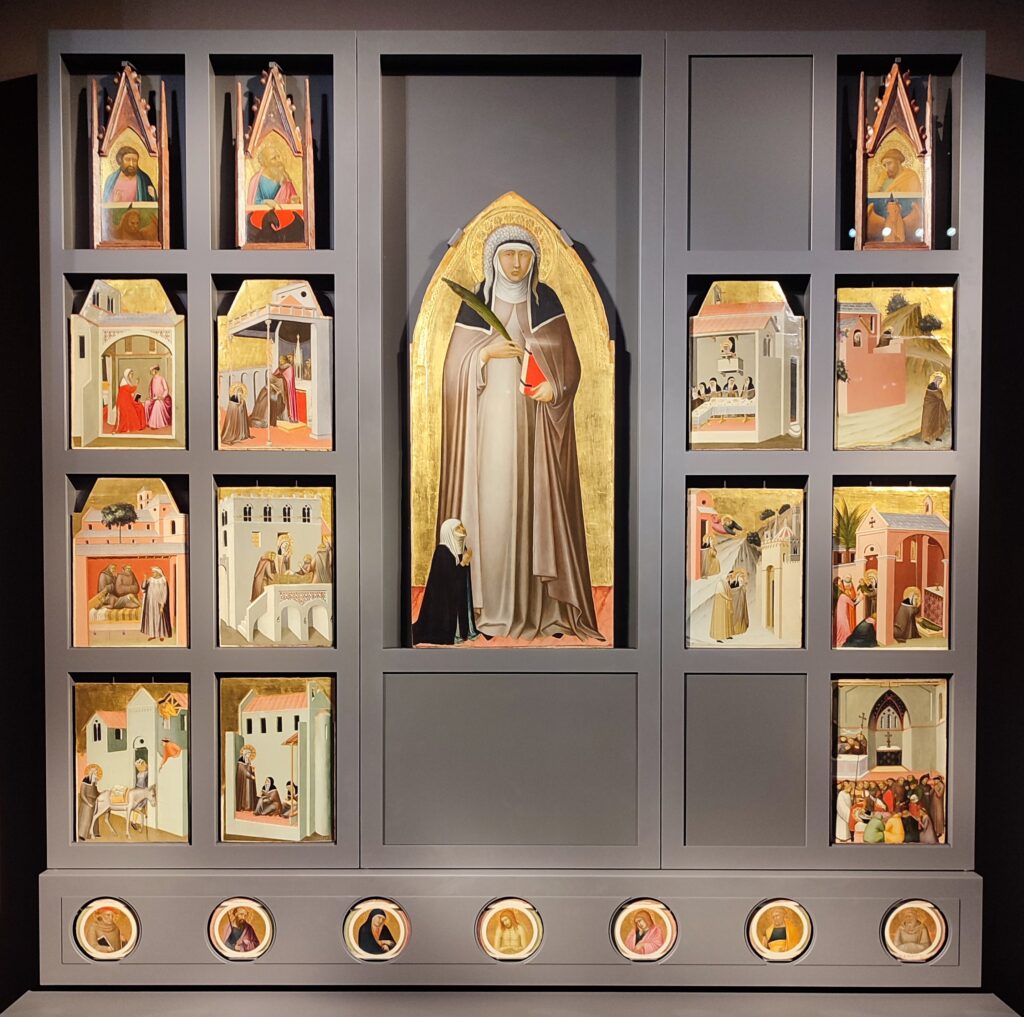
This blog post begins with a biography of Umiltà of Faenza (1226-1310), also known as Saint Humility or Saint Roxanne, an Italian nun who founded monasteries and lived as an anchoress for many years. It also presents my favorite quote from Umiltà and includes images and a description of a fourteenth century polyptych, with images of her life, that was painted by Pietro Lorenzetti.
Biography of Umiltà of Faenza
Umiltà was born in 1226 into a wealthy family that lived in Faenza, a town close to Ravenna, in northeastern Italy. Her parents, Elimonte and Richelda, named her Rosanna Negusanti, and at the age of fifteen, she was married to a nobleman named Ugoletto (Ugonotto) dei Caccianemici. She gave birth to two children, but they both died as infants. In 1250, Rosanna and Ugoletto together decided to enter the religious life in the double monastery Saint Perpetua, which was located near Faenza. Rosanna became a canoness who was known for her humilty, eventually taking the name Umiltà.
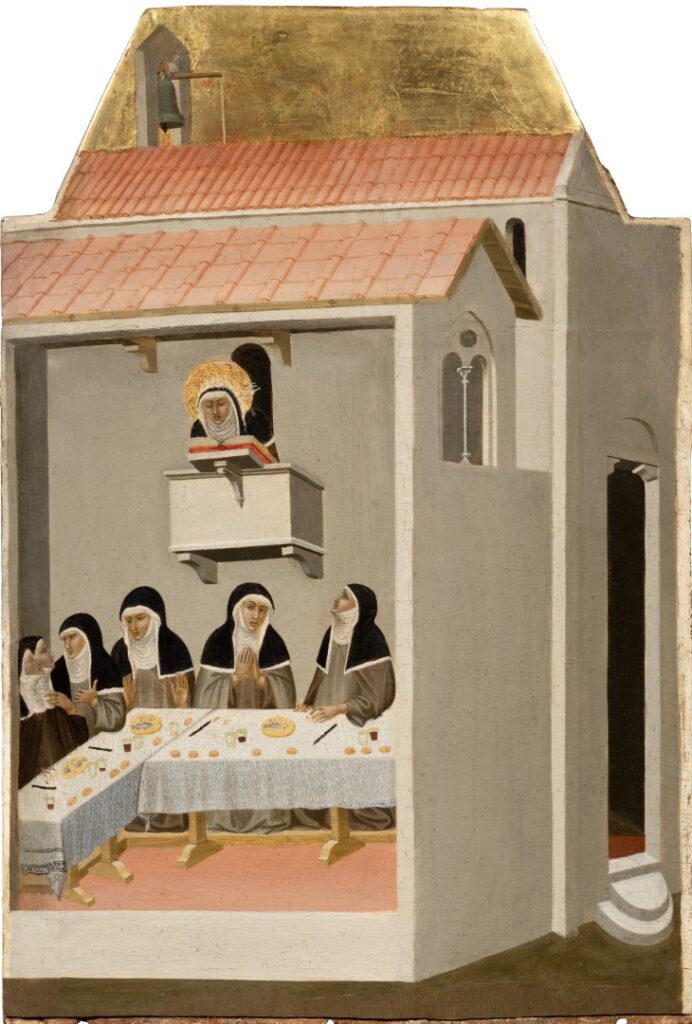
There is a story of her humility that, even though Umiltà was from a noble family, she was illiterate when she entered the monastery. One day, some of her sisters at the convent, who knew this, asked her to read to them. She humbly agreed and spoke words of wisdom to them, none of which were written in the book from which she was reading. She is reported to have said, “Do not despise the work of God, which is always true and just, though it is hard. In heaven shall be raised what is always humble.” She was later taught to read and write in Latin. During her years at Saint Perpetua, it is said that a Vallombrosan monk, who needed to have his feet amputated, was brought to Umiltà. She blessed him, making the sign of the cross over his feet and he was immediately healed.
Over time, Umiltà became drawn into silence and felt the need for more isolation and a contemplative life. Similar to Julian of Norwich (circa 1342-1416), Umiltà decided to become an anchoress, after recovering from a serious illness in 1254. For twelve years, she was sealed into a tiny cell that was attached to the Vallumbrosan church of Saint Apollinaris that had been established between 1012 and 1015 by Saint John Gualberto. She had one window that looked into the church, through which she could receive the sacraments, and another window overlooking the street, through which she could receive food and give prayers and advice to the townspeople. Although she was removed from secular life, she would still have been aware of what was going on politically and domestically in the community, through conversations with visitors who came to her looking for comfort and wisdom.
Other local women were inspired to build cells close to hers, living under her guidance. Eventually, the abbot of Vallombrosa decided that these women could join the order, and wanted Umiltà to be their abbess. In 1266, at the unusual request of the abbot general and the advice of Bishop Petrella, she sadly left her cell and founded a Vallumbrosan monastery (Santa Maria Novella alla Malta) outside Faenza, where she served as abbess for over fifteen years.
According to a story that has been passed down, one day the cellarer was given a small fish to prepare. Thinking it was only enough for the abbess, it was served to her in a delicious sauce, but Umiltà threw it down on the refectory floor. The cellarer rushed to pick it up and suddenly found that it was miraculously large enough to serve everyone.
Then in 1281, when Umilta would have been around 55 years old, Faenza was being torn apart by the military conflict between the Guelphs (supporting the pope) and the Ghibellines (supporting the Holy Roman Empire). While the nuns were respected by the soldiers, the monastery itself was pillaged. Umiltà initially intended to move to Venice but was inspired by Saint John the Evangelist and decided to establish a monastery in Florence instead. The political and military hostility between the Ghilbellines and the Guelphs had been ongoing for many years, at least since the Guelphs had decapitated the Abbot Tesoro of Vallombrosa in 1258. So Umiltà chose to go to Florence, with some thought of trying to make peace between the warring factions.
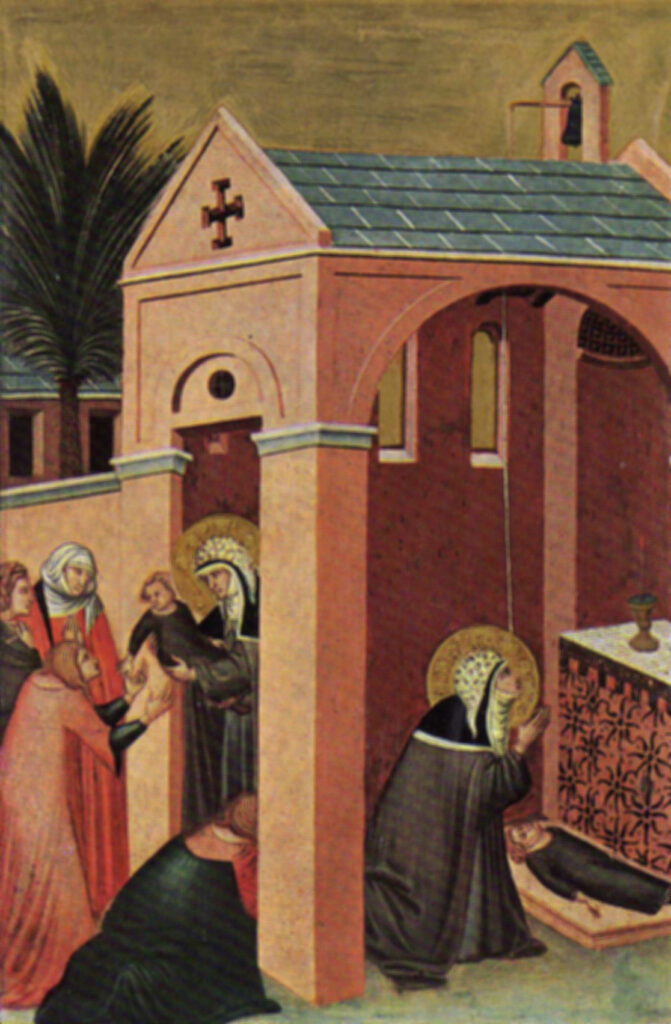
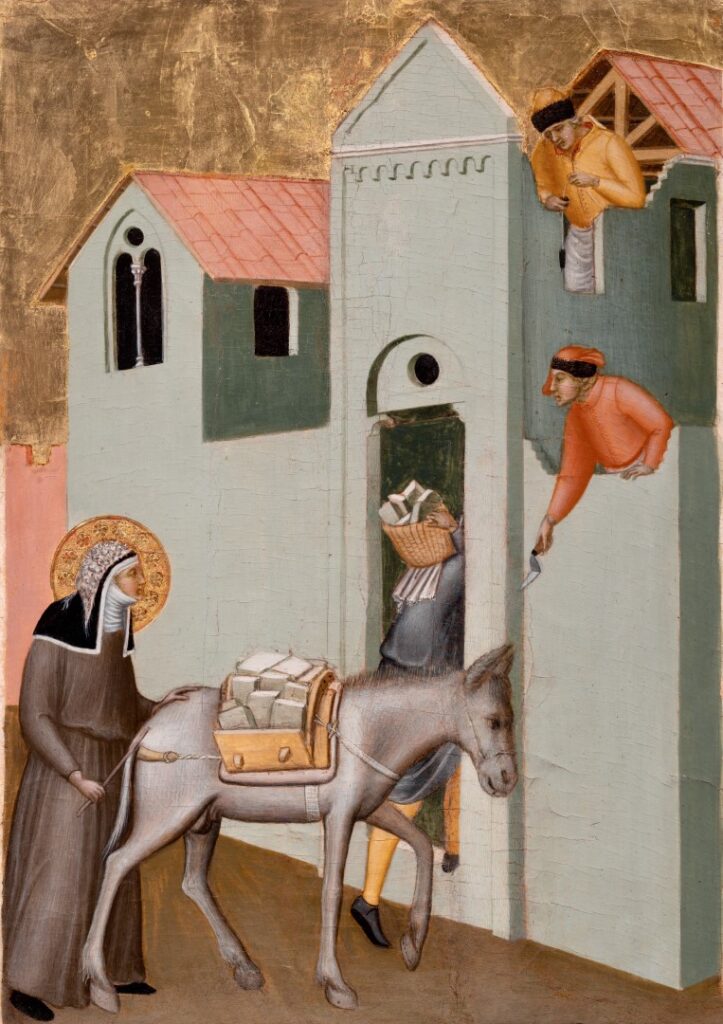
One day, while she was delivering bricks to build the monastery, a dead boy was brought to her by the nurse who was responsibile for him. Umiltà took the boy into a nearby shrine and laid the body at the feet of an image of Saint John the Evangelist. Then she used a candle to make the sign of the cross over him, and he miraculously opened his eyes and was raised from the dead.
In 1282, Umiltà founded the San Giovanni Evangelista monastery in Florence, which was dedicated to Saint John the Evangelist and consecrated by the Bishop Francesco Monaldeschi in 1297. It was at this time that she dictated to her sisters The Sermons, a shining example of medieval mystic literature. It was said that a white dove with golden feet and and a golden beak would appear near her ears during her dictation.
According to reference 1, Umiltà experienced a stroke, losing her speech and mobility, on December 13, 1309, which was the feast day of Saint Lucy. She died at the monastery in 1310, leaving behind writings that include nine Latin sermons and Lauds to the Virgin Mary in verse.
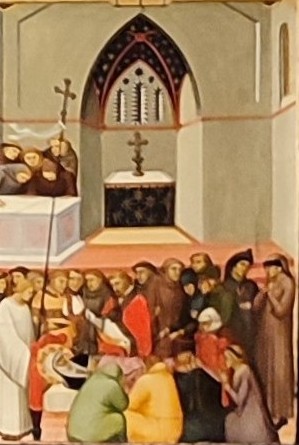
After her death, many miracles were attributed to Umiltà. A Vallombrosan monk was healed of a crippled arm that had prevented him from celebrating Mass. A woman who had been ill for five years to the point that she could not speak or swallow, was healed. Another woman with a stomach tumor was likewise healed.
Umiltà was formally canonized as a saint in January 1720 by Pope Clement XI. In 1942 she was declared co-patron of Faenza and altars were dedicated to her, in the two Vallumbrosan monasteries she founded. Umiltà’s feast day is celebrated each year on May 22.
Umiltà of Faenza’s Writings
The first time I had ever heard of Umiltà was when I was paging through reference 4, Incandescence: 365 Readings with Women Mystics. This book includes an extremely short biography of Umiltà and provides nine quotes from her writings. My favorite is this one:
You know my roots well. You know how they were planted, how they grew, and how they were disseminated. These roots of mine took my heart and mind, and bound my soul with a chain of love. Jesus, Cultivator of Virtues, do not let the root planted in my heart dry out. Help it spread. The root is the heart’s intent. It is led by love to do good. If my root pleases you, Lord, make its branches sprout, so everyone can see my leaves, flowers, and fruit growing and praising your name.
(Umiltà of Faenza 1226-1310)
It appears somewhat difficult to find Umiltà’s writings, at least in English. A quick Amazon search turned up two editions of her Sermons in Italian, but they seem to be out of print. You can, however, find an excerpt about angels from her fourth sermon at the link in reference 2.
Polyptych Altarpiece by Pietro Lorenzetti
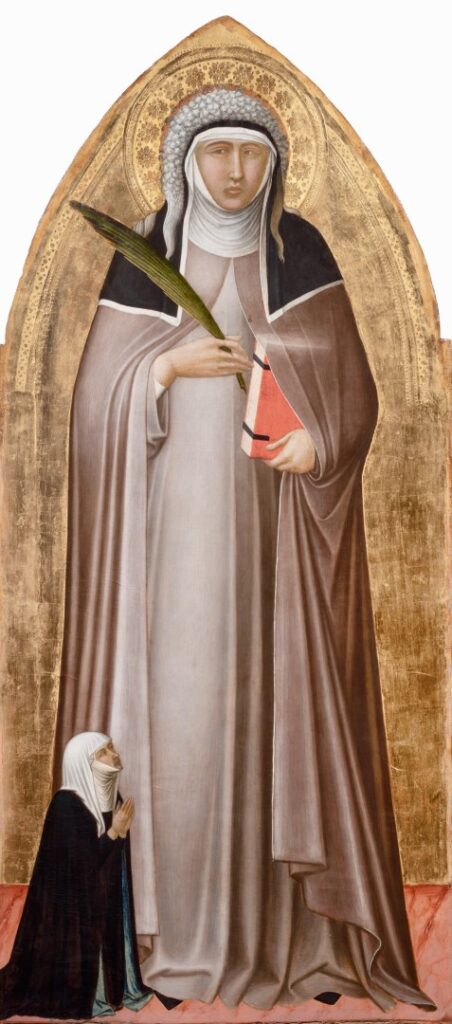
Pietro Lorenzetti painted a gorgeous polyptych altarpiece (circa 1330-1335) to commemorate Umiltà’s burial in the church of San Giovanni Evangelista in Florence, the convent she had founded in 1282 and of which she was the abbess until her death in 1310. Hagiographic altarpieces originated in the Byzantine world, were closely associated with the veneration of relics, and became popular in Italy beginning in the 13th century. Similar to other such pieces of artwork, this polyptych illustrates significant episodes in Saint Umiltà’s life and the stories and legends that were passed down about her.
The polyptych, a masterpiece of Gothic painting shown in image 1, consists of a portrait of Umiltà that is surrounded by scenes from her life and a row of four pieces (one missing) at the top that depict the four Evangelists. It is currently in the collection of the Uffizi Museum in Florence.
In the portrait detail of the saint in image 6, Umiltà is wearing the habit of her religious order and is holding a book and a palm leaf, symbolic of glory. According to reference 3, her head is covered with sheepskin, an iconographic characteristic expressing humility. At the bottom left of the image, a woman is kneeling in prayer, which is the typical iconographic mechanism used to include in the artwork the donor or person who commissioned it.
Reference 3 provides the following description of the scenes of her life, “The stories surrounding the central image recount Saint Humility’s life, from the moment she chooses to don the religious habit before her conversion, to the miracles she worked in the convent in Faenza, to her journey to Florence where, in 1282, she founded the monastery of San Giovanni Evangelista just outside the city walls, until her death and funeral service presided over by the priest. The lively narrative of the scenes, set in architectural environments and landscapes which abound with realistic details, is clear and informative, reiterating the educational purpose that images played in an era when literacy was a skill known only to the few.”
This altarpiece by Pietro Lorenzetti remained in the church of San Giovanni Evangelista until around 1529, when the nuns were forced to abandon the convent, as Florence came under siege. After moving several times, the nuns arrived at the monastery of San Salvi, bringing with them their most treasured furnishings, including this representation of the life of Umiltà of Faenza.
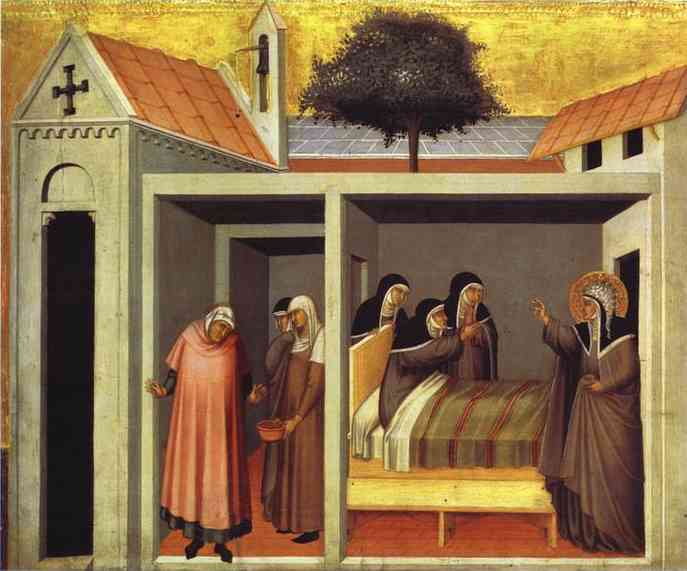
During the Napoleonic era, when the monasteries were dissolved, the altarpiece was broken up into pieces and put into storage in Florence. It is currently missing the frame, two pinnacles and two story panels, the latter of which are displayed at the Staatliche Museen, Gemäldegalerie in Berlin.
Reference 1: La Beata Umiltà: Contemplating on Holy Humility, https://www.umilta.net/umilta.html.
Reference 2: Angels: Sermon 4 : On The Holy Angels, by Umiltà of Faenza, blog post at The Value of Sparrows website, July 16, 2013.
Reference 3: Through Images and Colors: The Story of Saint Humility of Faenza in the Medieval Masterpiece at the Uffizi Gallery, description of an exhibit of the altarpiece at The Pinacoteca Museum at Faenza, October 31, 2023 – May 26, 2024.
Reference 4: Carmen Acevedo Butcher, Incandescence: 365 Readings with Women Mystics, Paraclete Press, Brewster, MA, 2005.
Image 1: The Polyptych of the Life of Umiltà, Pietro Lorenzetti,1330-1335, Uffizi Museum, inventory number 1890 nn. 6120-6126, 6129-6131, 8347.
Image 2: Detail from Polyptych of the life of Umiltà, Pietro Lorenzetti,1330-1335, Umiltà reads to her fellow nuns during meal at refrectory in convent of Santa Perpetua.
Image 3: Detail from Polyptych of the life of Umiltà, Pietro Lorenzetti,1330-1335, Umiltà delivers bricks to build her monastery.
Image 4: Detail from Polyptych of the life of Umiltà, Pietro Lorenzetti,1330-1335, Umiltà raises a child from the dead.
Image 5: Detail from Polyptych of the life of Umiltà, Pietro Lorenzetti,1330-1335, The funeral of Umiltà.
Image 6: Detail from Polyptych of the life of Umiltà, Pietro Lorenzetti,1330-1335, portrait of Umiltà with a donor.
Image 7: Detail from Polyptych of the life of Umiltà, Pietro Lorenzetti,1330-1335, Umiltà heals a sick nun. This is one of the two panels that are on exhibit at the Staatliche Museen, Gemäldegalerie in Berlin.









Leave a Reply
Join the conversation by submitting a comment to this blog post below.