Lectio divina is an ancient monastic spiritual practice, dating back to the early church, when the scholar, patristic father, and theologian, Origen of Alexandria (circa 185–253 CE), advocated scriptural reflection and interpretation and wrote about “scripture as a sacrament.” Origen believed that Christ, as the Word, was incarnate in the scriptures, and he passed his teachings on to Ambrose of Milan (circa 339–397 CE). Ambrose, in turn, taught Saint Augustine (354–430 CE), and an emphasis on reading and reflection on the scriptures was subsequently passed down to the Western monastic tradition.
Last year I released a blog post that describes the spiritual practice of lectio divina. Now in today’s blog post, I build on that information and present three models of how to pray lectio divina: the scholastic method, the monastic method, and the spiral method. Of course, any model has the potential to oversimplify or provide rigidity to the process, but having guidelines gives us the outline of a place to begin.
Scholastic Model
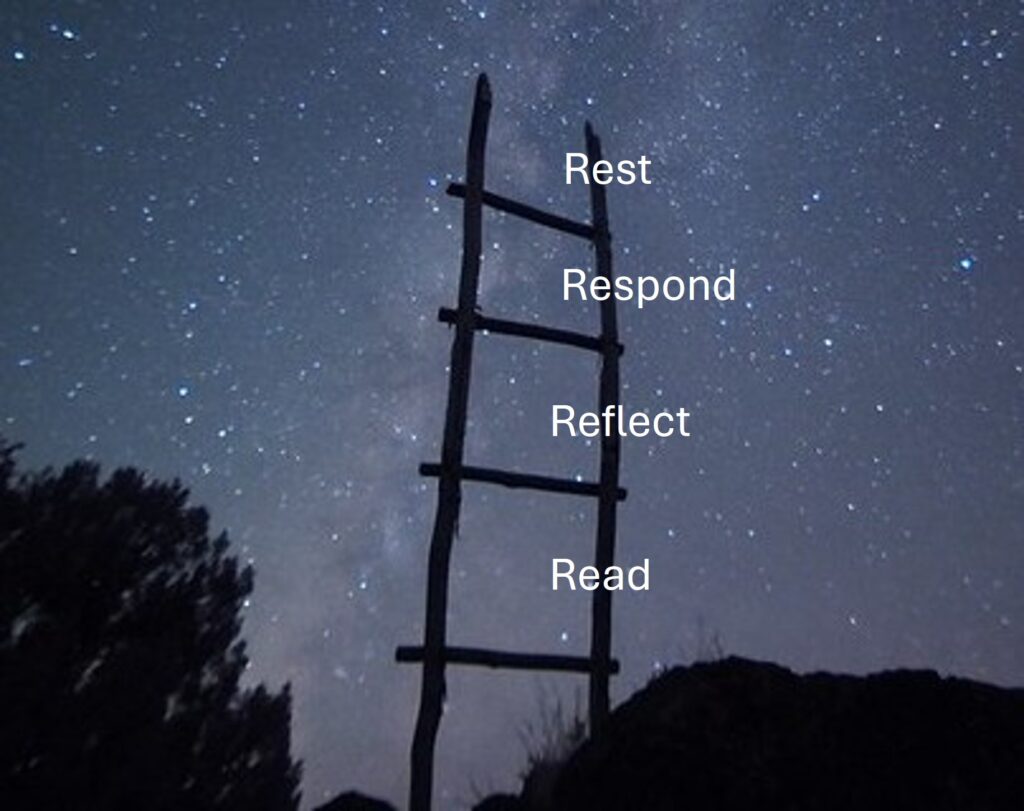
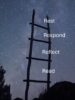
The scholastic way of praying lectio divina initially developed during the Middle Ages, a time when the spiritual life relied more on rational theological analysis than personal experience. Beginning in the sixth century CE, the communities of Saint Benedict and his sister Saint Scholastica prayed with scriptures in this way. In the Benedictine rule, it is written that one should listen to instructions and “attend to them with the ear of your heart.” The first formal description of lectio divina was written by Guigo II, a Carthusian monk who was the prior of the Grande Chartreuse Monastery from 1174-1180 CE, in what is now Southeastern France. This letter on the contemplative life, The Ladder of Monks, is sometimes also called The Ladder of Paradise. It describes the structure of lectio divina as four progressive steps or rungs of a ladder, which are Lectio (Reading), Meditatio (Meditation), Oratio (Prayer), and Contemplatio (Contemplation). These steps are often referred to as reading, reflecting, responding, and resting.
In traditional, scholastic lectio divina, the text, usually selected Bible verses, are read four times—once before each step of prayer—moving through a process of reading for comprehension, meditating on a connection to your life’s journey, praying to God in response to the first two steps, and finally, resting in contemplation. This scholastic model, as depicted in Image 1, provides a good structure for beginners, since it proceeds step-by-step through the four prayer stages, keeping silence for meditation between readings. Importantly, this structure is arranged so that the prayer progresses inward as we develop our relationship with God—moving from acquaintance to friendship to intimacy. However, it should not be seen as a prescriptive, hierarchical model, where you climb up higher and higher to contemplation. Rather, even after a few times of praying with the scholastic model, you will find that this prayer does not unfold in a straight line and that there is a lot of back and forth and overlap in the four steps.

Monastic Model
The monastic way of praying lectio divina is a more ancient prayer method that was practiced by the desert monastics who lived in Syria, Palestine, and Egypt during the fourth and fifth centuries CE. Because manuscripts were expensive and hard to come by, the ammas and abbas memorized the scriptures that they used for meditation. Their ascetic communities honored repetitive rumination and slow pondering of scripture passages.
This monastic method, as shown in Image 2, is oriented more toward contemplative prayer than the scholastic form. In this model, Sophia Holy Wisdom is at the center of a circle, with four “moments” arranged around the circumference. All four are joined to each other and to the center, which is the Spirit of God speaking to us through the text and in our hearts. To engage with any one of the four moments is to be in direct relationship with all the others. In this perspective, you can start at any moment around the circle and move organically in prayer, simply by going where the Spirit leads.
Spiral Model
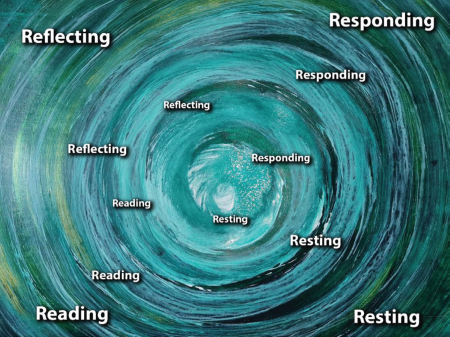
Finally, the spiral way of praying lectio divina reimagines the moments (read, reflect, respond, rest) as four slow spiral movements. Together, they form a single, gradually evolving and unfolding spiral motion, as seen in Image 3. This prayer form is spiral, because of the repeated nature of the reading/gazing process, where every repetition brings us back to a slightly different place. Ideally, each movement flows gently into the next, sort of like transitioning from one yoga pose to another.
This model dates back at least as far as a sixth-century monk from Syria, named Denis the Pseudo-Aeropagite. He spoke about contemplative prayer as being like a corkscrew, endlessly spiraling deeper into God. You can imagine the spiral winding outward into the world or inward toward our deepest selves where God resides. This is not necessarily a better or more advanced way of praying, and I have found it difficult to implement. However, I wanted to mention the possibilities of this model anyway, in case it sparks your curiosity and works for you. In my mind, it is easier and more constructive to think of the spiral as a model for our evolution that comes from praying the same texts multiple times.
Reference 1: Christine Valters Paintner, Lectio Divina—The Sacred Art: Transforming Words and Images into Heart-Centered Prayer. (Nashville, TN: SkyLight Paths Publishing, 2011)
Reference 2: Unpublished, “Introduction to Lectio Divina—Course Handouts,” Center for Contemplative Living, Contemplative Outreach of Colorado, January 2021.
Reference 3: Michael Casey, Sacred Reading: The Ancient Art of Lectio Divina. (Liguori MO: Liguori Publications, 1995)
Reference 4: Guigo II, Lectio Divina: The Ladder of Paradise, An Early Guide to Lectio Divina, ed. and trans. Javier Morin, (Independently published, 2014), Kindle.
Image 1: Four Steps of Scholastic Model, photograph by Mike Lewinski, adapted by Julie Henkener 2025.
Image 2: Four Moments of Monastic Model, graphic by Julie Henkener, 2025.
Image 3: Four Movements of Spiral Model. Image by Kerstin Klink, adapted by Nick Zelinger, 2025.







Leave a Reply
Join the conversation by submitting a comment to this blog post below.