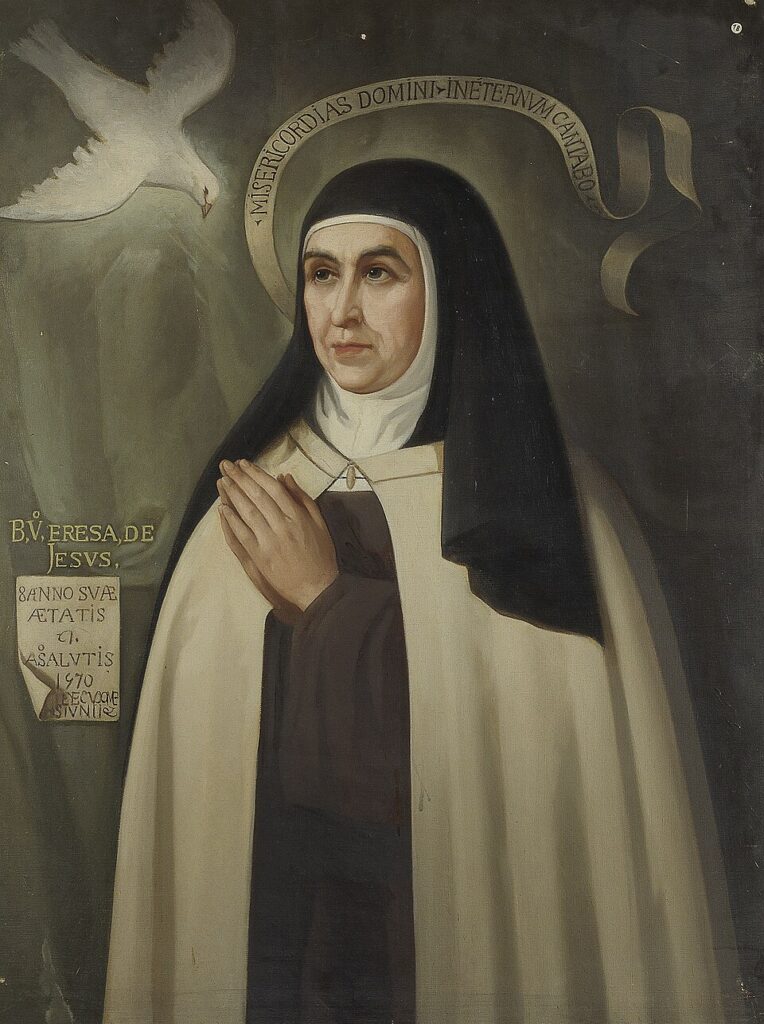
Teresa of Ávila was a sixteenth century nun from Ávila, Spain, who wrote spiritual treatises, founded monasteries, and is one of only a few women to be honored as a Doctor of the Catholic Church. She was a mystic, religious reformer, author, and theologian of the contemplative life.
This blog post provides a short biography of Teresa of Ávila, various images of Teresa, a few details from my visit to her convent in Ávila, and the famous bookmark quote from Teresa.
Teresa of Ávila (1515-1582) was born in either Ávila or Gotarrendura and was named Teresa Sánchez de Cepeda y Ahumada. Her father, Alonso Sánchez de Cepeda, was a successful wool merchant and one of the wealthiest men in Ávila. When she was fourteen years old, her mother (Beatriz de Ahumada y Cuevas) died, leaving her desolate with grief. This experience led her to seek a deeper devotion to the Virgin Mary as her spiritual mother. Teresa loved popular fiction, mostly medieval tales of knighthood and books about fashion, gardens and flowers. She was educated as a Spanish noblewoman at the Augustinian nuns’ school in Ávila, and initially resisted the idea of a religious vocation. However, gradually she became convinced that she should enter religious life. At the age of 20, she left home secretly and entered the local, relatively relaxed Carmelite Convent of the Incarnation. Between 1538 and 1542, Teresa spent much time in bed and nearly died. She was paralyzed for almost three years and subsequently attributed her recovery to the intercession of Saint Joseph (San José). After her father died in 1543, the Dominican Vicente Barron became her confessor, and she began having experiences of religious ecstasy.
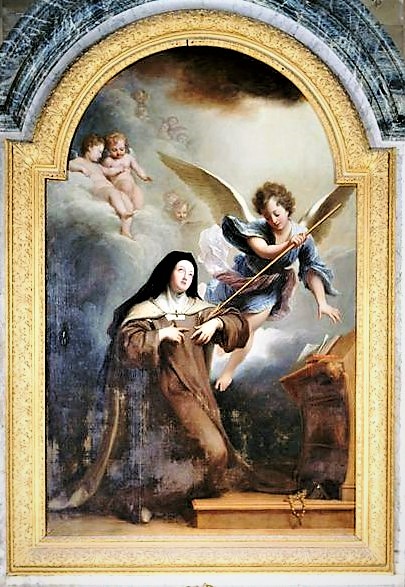
On the feast day of Saint Peter in 1559, Teresa became convinced that Jesus had invisibly presented himself to her in bodily form. This initiated a series of visions that continued almost without interruption for more than two years. In one particular vision, which is called the transverberation, a seraph repeatedly drove a golden spear into her heart, causing her ineffable spiritual and bodily pain that she described as follows:
I saw in his hand a long spear of gold, and at the point there seemed to be a little fire. He appeared to me to be thrusting it at times into my heart, and to pierce my very entrails; when he drew it out, he seemed to draw them out also, and to leave me all on fire with a great love of God. The pain was so great, that it made me moan; and yet so surpassing was the sweetness of this excessive pain, that I could not wish to be rid of it.
Libro de Mi Vida, Autobiography of Teresa of Ávila
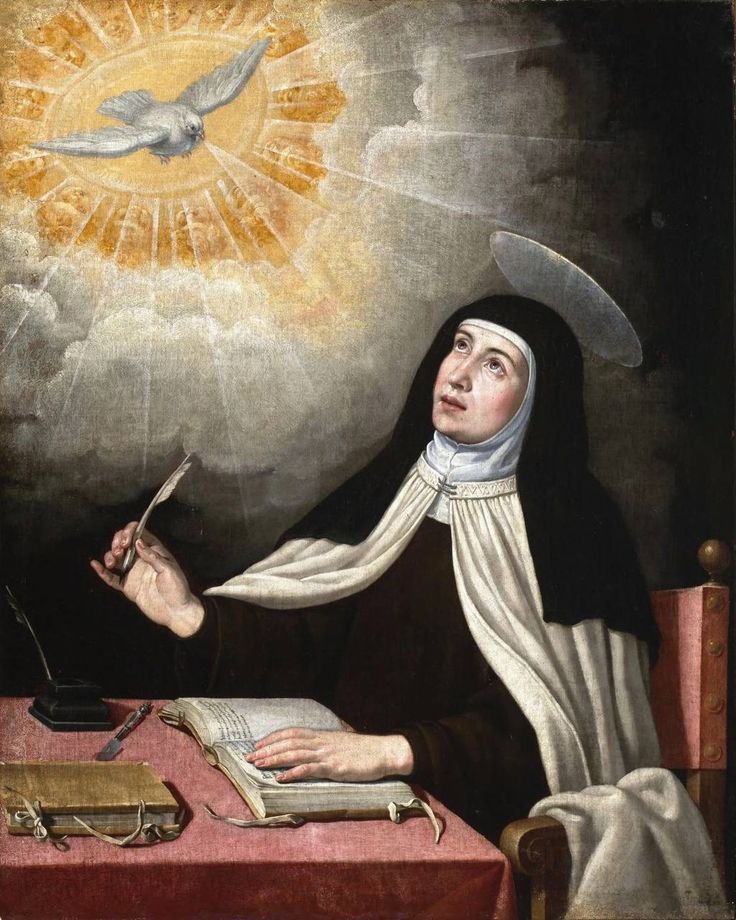
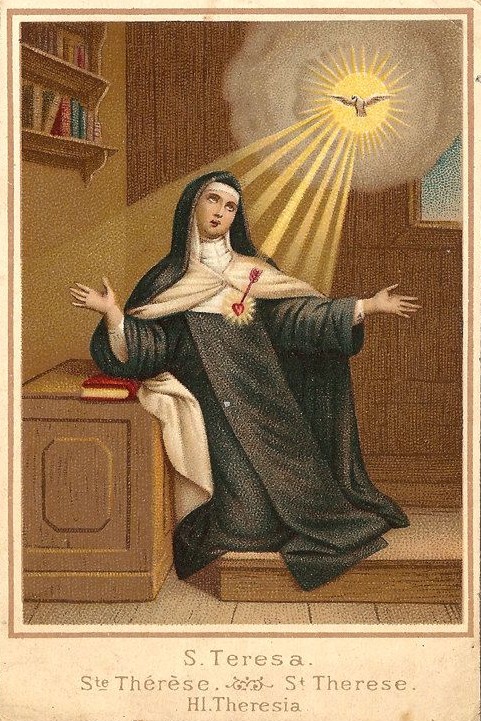
Teresa’s best-known book is The Interior Castle, a spiritual guide that was carefully written to avoid gaining the attention of the Spanish Inquisition. Written in 1577 and published posthumously in 1588, in it she uses the illustration of seven mansions within the “castle of the soul” to describe the stages the soul moves through as it journeys toward a deeper union with God. Because of her writings, she is often depicted in paintings as working at her desk, under the inspiration of the Holy Spirit, who is often symbolized by a dove. Other books by Teresa include The Way of Perfection, The Book of Her Life, and The Book of Her Foundations.
In addition to her life of contemplation and writing, Teresa of Ávila was a woman of action. Over the years, she had begun to see the Convent of the Incarnation as not sufficiently cloistered. She was drawn to a lifestyle that was more simple and quiet than that provided at her convent. Beginning in 1562, based on insights she obtained from her mystical experiences, she initiated reforms to correct the lax spiritual practices of the Carmelite order. Despite resistence from the community, she founded a new monastery, with vows of abject poverty, that she named after her patron saint, San José. Between 1567 and 1571, Teresa traveled widely in Spain to promote church reformation. During this time, she established at least seven new convents, This work of reform and the establishment of new monasteries was difficult, but she persevered in the face of illness, frequently rugged travel, and fundraising challenges. With the help of Anthony of Jesus and her close friend John of the Cross, Teresa also founded two new monasteries for brothers.
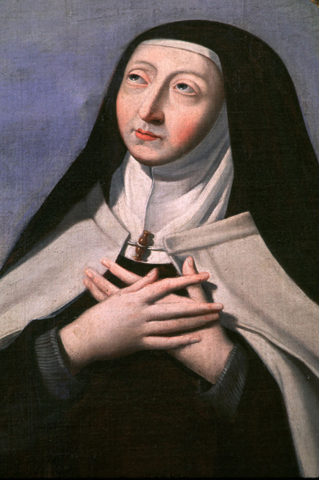
Starting in 1576, unreformed members of the Carmelite order began persecuting Teresa, her supporters and her reforms. At the request of the order, she “voluntarily” retired to St. Joseph’s convent in Toledo. She appealed to King Phillip II, and in 1579, her case before the Spanish Inquisition was dropped, allowing her reforms to move ahead again. During the last three years of her life, Teresa founded reformed convents at Villanueva de la Jara (1580), Palencia (1580), Soria (1581), Burgos, and Granada (1582). Her final illness began while she was traveling, and she passed away at her Monastery of the Annunication in Alba de Tormes. Her death occurred right as Europe was moving from the Julian calendar to the Gregorian calendar. Because of this, she died either on October 4 or October 15, 1582. According to the liturgical calendar being used at the time, she passed away on October 15, which is when her feast day is celebrated.
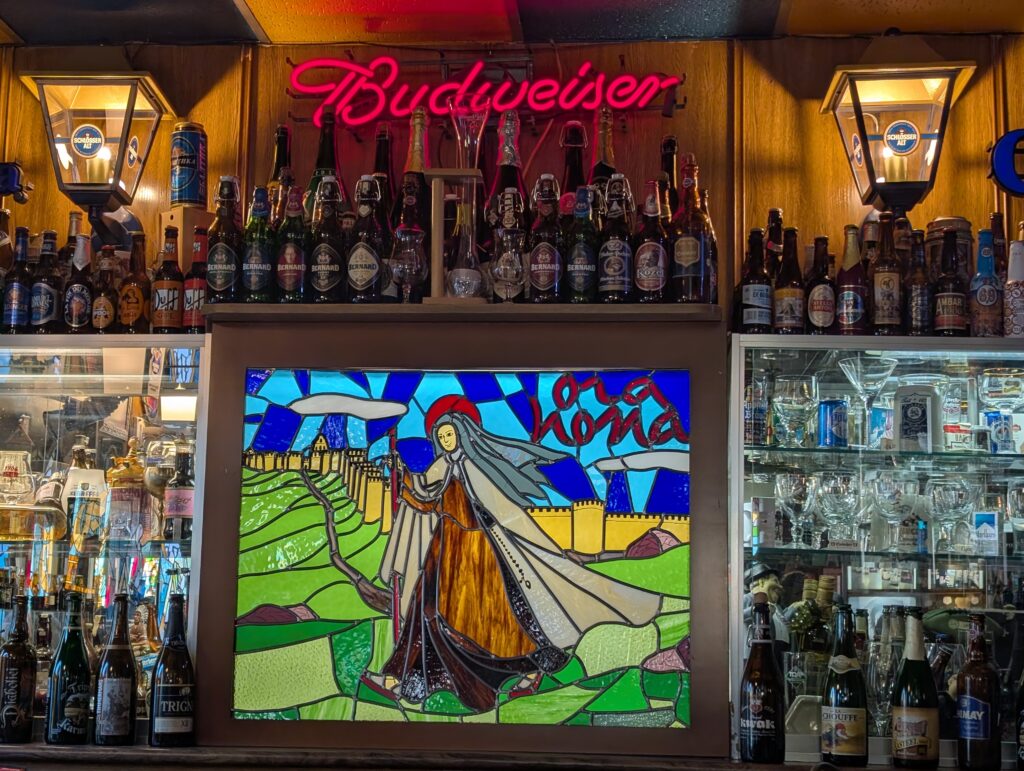
This past November, my husband Andy and I were fortunate to be able to travel to Spain, and we spent some time in Ávila. We went first to the Basilica, then we stopped at a tiny cafe for coffee and a bathroom break, on the way to Teresa’s convent. In this cafe, I found this delightful stained glass depicting the saint, centered directly below a Budweiser sign. LoL.
Of course I wanted to include a quote by Teresa of Ávila in my book, Women Give Voice to Wisdom: Praying Lectio-Visio Divina, and was really drawn to one in particular. The story is that this saying was originally found written on a bookmark that Teresa used, and it is attributed to her. About a year or two ago, I came across an image online that seemed like it might be a photograph or reproduction of the bookmark, but I couldn’t find an attribution for it.
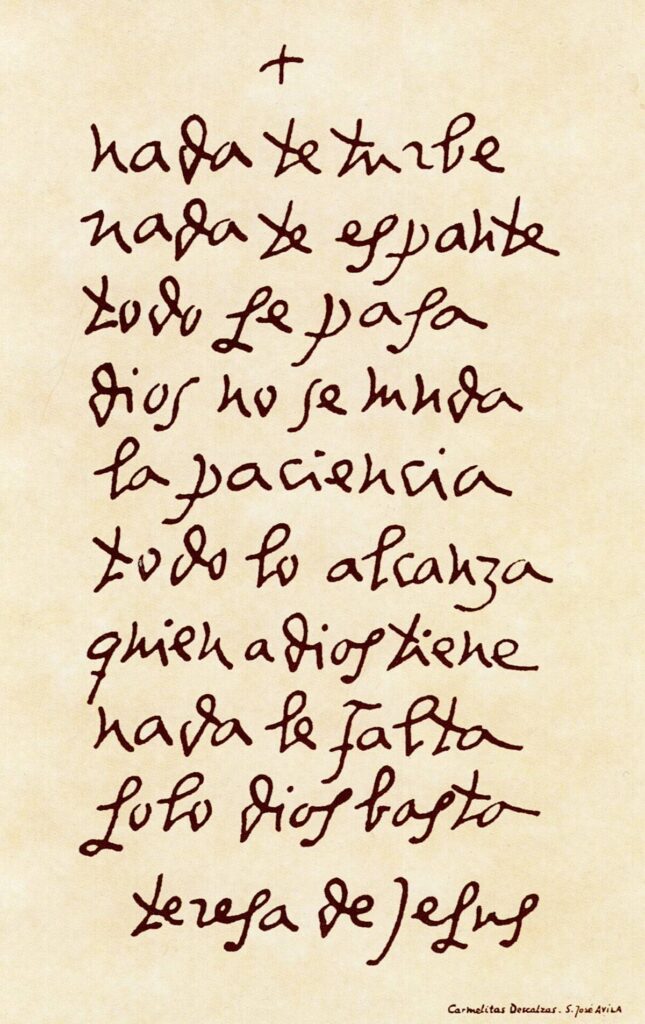
So, when I was at her convent, I found that they were selling reproductions of it – of course I bought a copy that I have scanned and is shown here. I am fairly certain that this is Teresa’s handwriting, because there were a couple of other documents posted at the convent in this same distinctive script. In addition, you can see an image of a letter she wrote on the Wikipedia page on Teresa of Ávila in this same handwriting. If not actually written by her, it would have been copied down by one of Teresa’s Carmelite nuns somwhere down the line. The quote in Spanish is:
Nada te turbe.
Nada te espante.
Todo se pasa.
Dios no se muda.
La paciencia todo lo alcanza.
Quien a Dios tiene, nada le falta
Solo Dios basta.
Teresa de Jesús (1515-1582)
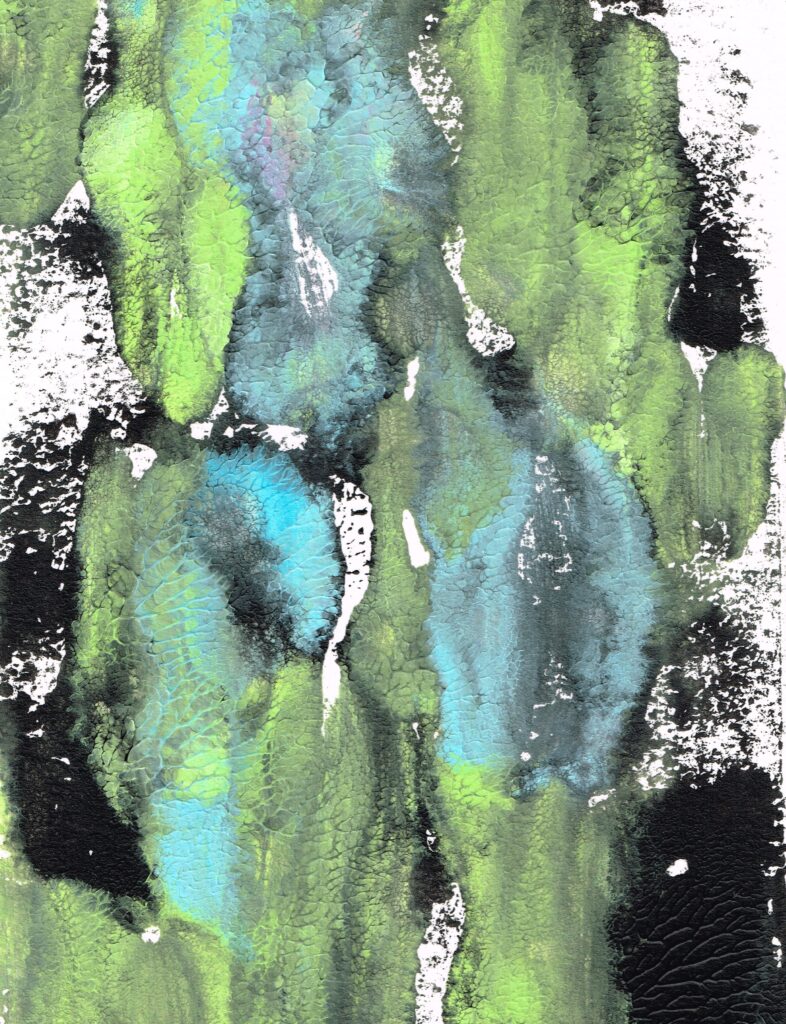
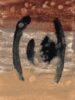
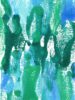
Here is my own translation into English and the acrylic monoprint I made to go with it:
Let nothing disturb you.
Let nothing scare you.
All things pass.
God never changes.
Patience attains all that it strives for.
Those who have God, lack nothing.
God alone is enough.
Teresa of Jesus (1515-1582)
Teresa of Ávila was canonized in 1622 and, along with Catherine of Siena, was named as one of the first female Doctors of the Church in 1970. The other two are Hildegard of Bingen and Thérèse of Lisieux. The title Doctor of the Church is used for saints who show, through their personal holiness and writings, a significant contribution to Catholic theology. Teresa’s main contribution relates to communicating her mystical understanding of prayer and the spiritual life. As a woman of faith, she is an excellent guide and source of knowledge for those who seek a deeper personal union with Christ. I have to admit that I couldn’t get all the way through The Interior Castle, though… If you have read the book, I’d love to hear your thoughts. Please consider paging down and leaving a comment.
Reference 1: Duffy, Margaret, Teresa of Avila – Mystic, Practical Woman, Doctor of the Church, blog post at Ad Imaginem Dei website, October 15, 2023.
Reference 2: Viar, Lucas, Saint Teresa of Avila’s Biretta: A Brief Introduction to the Iconography of St. Teresa of Avila as Doctrix Ecclesia, Liturgical Journal, October 16, 2020.
Reference 3: Teresa of Ávila, The Interior Castle, Kieran Kavanaugh and Otilo Rodriguez, trans., Paulist Press, Mahwah, NJ, 1979.
Reference 4: Broughton, Rosemary, Praying With Teresa of Ávila, The Word Among Us Press, Ijamsville, MD, 1990.
Image 1: Anonymous Copy of the Only Known Portrait of Saint Teresa, Painted from Life by the Carmelite friar Juan de la Miseria, 1877, Museo National del Prado.
Image 2: Jean-Baptiste Santerre, The Transverberation of Saint Teresa of Avila, French, 1710, Versailles, Chateaux de Versailles et de Trianon, Chapel.
Image 3: Anonymous Copy of Jose de Ribera, Santa Teresa de Jesús, Spanish, 17th Century, Museo Nacional del Prado.
Image 4: Undated Illustration of Teresa of Avila from church in Troyes, France, (OSV News files/Nancy Phelan Wiechec/Crosiers).
Image 5: Stained Glass Image of Teresa of Ávila, photograph by Julie Henkener, November 3, 2025.
Image 6: Teresa of Avila’s Bookmark Quote, Convent, scanned to an image by Julie Henkener, December 29, 2025.
Image 7: Nada te Turbe, Julie Henkener, 2025.
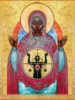
Image 8: Holy card image of Saint Teresa of Ávila, widely circulated on Pinterest.





Leave a Reply
Join the conversation by submitting a comment to this blog post below.