This blog post presents the O Antiphon for the apostle Thomas that was previously used on his feast day, December 21. It also describes three iconographies of Thomas related to the post-resurrection story of Thomas examining the wounds of Jesus and his subsequent admission of faith. I wrote a blog post about the O Antiphons in 2019, and I loved picking out the image to illustrate each one. If you aren’t familiar with the O Antiphons or need a refresher, please check out my 2019 blog post here.
In the Roman tradition, there are seven standard O Antiphons that are traditionally chanted before and after the Magnificat during Vespers (evening prayer) in the last week of Advent, leading up to Christmas. These O antiphons are O Sapientia, O Adonai, O Radix Jesse, O Clavis David, O Oriens, O Rex Gentium, and O Emmanuel. In some traditions, there is an eighth O antiphon, O Virgo Virginum, that is sung on December 24.
One source of historical information about the O Antiphons can be found in the writings of Dom Prosper Guéranger, the Benedictine abbot of Solesmes in France from 1837-1875. He was an influential monastic and liturgist, who was dedicated to making liturgical information and commentary more widely known to the faithful in the pews. Guéranger wrote fifteen volumes (that he never completed) that follow the cycle of the liturgical year, illuminating the traditional liturgy with his interpretations and rich observations, collected from both Eastern and Western Christian traditions.
About the O Antiphons, he writes, “In the Roman Church, there are seven of these antiphons, one for each of the greater ferias. They are commonly called the O’s of Advent, because they all begin with that interjection. In other Churches, during the middle ages, two more were added to these seven; one to our blessed Lady, O Virgo virginum; and the other to the angel Gabriel, O Gabriel; or to St. Thomas the apostle, whose feast comes during the greater ferias; it began O Thoma Didjme. There were even Churches where twelve great antiphons were sung; that is, besides the nine we have just mentioned, O Rex Pacifice to our Lord, O mundi Domina to our Lady, and O Hierusalem to the city of the people of God.” He also indicates that O Thomas was “almost universally substituted” for O Gabriel, beginning in the 13th century.
The usual O Antiphon for December 21, which is also the Winter Solstice, is O Oriens (O Rising Dawn), but December 21 was also once the feast day of Saint Thomas. And who doesn’t love and identify with the story of Doubting Thomas? (In 1969, the Catholic Church changed his feast day to July 3 in order to deconflict with Advent.)
O Thomas – Antiphon for December 21
O Thomas Didymus! who did merit to see Christ; we beseech you, by most earnest supplication, help us miserable sinners, lest we be condemned with the ungodly, at the Coming of the Judge.
O Thomas Didyme! qui Christum meruisti cernere; te precibus rogamus altisonis, succurre nobis miseris; ne damnemur cum impiis, in Adventu Judicis.
References 2 and 3 appear to quote a summary or entry for December 21 from volume 1 of Guéranger’s book The Liturgical Year. If I read this correctly, it indicates that the O Thomas antiphon may have been used in addition to the O Oriens antiphon, at least in some Catholic communities. This entry begins with Guéranger’s commentary about Saint Thomas and a statement of the O Thomas Antiphon. It continues with the following prayer from Matins of the Gothic or The Mozarabic Breviary:
“O Lord Jesus Christ, who hast placed on the head of thy Martyr, Thomas the Apostle, a crown made of that precious stone, that is founded in the foundation; that so he might not be confounded, because he believed in thee; nor be uncrowned, because he laid down his life for thee; may there be, by his intercession, in us thy servants, that true Faith, whereby we may confess thee with most ready hearts before persecutors: that thus, by the same great Martyr’s intercession, we may not be confounded before thee and thy Angels. Amen.”
It continues with a hymn about Thomas (taken from the Menoea of the Greeks,) that is followed by the O Oriens antiphon, and concludes with an Advent hymn, taken from The Mozarabic Breviary, Monday of the Fifth Week, Oratio. However, I have found this short sequence of prayers a bit confusing, because it doesn’t specifically state that these prayers were all used together in this order at Vespers services. Perhaps some parts of this prayer entry were used during a different part of the day, such as at Matins, since that word is referenced in Guéranger’s text.
Doubting Thomas Iconography
Thomas Didymus (Δίδυμος or Didymos in Greek) was one of the apostles of Jesus. According to tradition, he established churches in Ethiopia, Mesopotamia, and what is now India. It is also said that Thomas baptized the Magi during his travels in the East. And several Eastern Orthodox Churches trace their history and liturgical rites directly back to St. Thomas.
It happened that one of the Twelve, Thomas – nicknamed Didymus or “Twin” – was absent when Jesus came. The other disciples kept telling him, “We’ve seen Jesus!” Thomas’ answer was, “I’ll never believe it without putting my finger in the nail marks and my hand into the spear wound.” On the eighth day, the disciples were once more in the room, and stood before them, saying, “Peace be with you.” Then to Thomas, Jesus said, “Take your finger and examine my hands. Put your hand into my side. Don’t persist in your unbelief, but believe!” Thomas said in response, “My Savior and my God!” Jesus then said, “You’ve become a believer because you saw me. Blessed are those who have not seen and yet have believed.” (John 20:24-29)
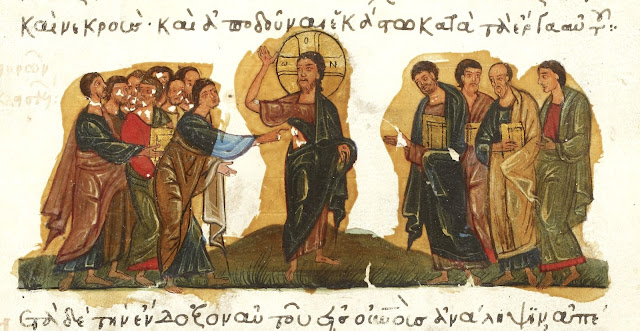
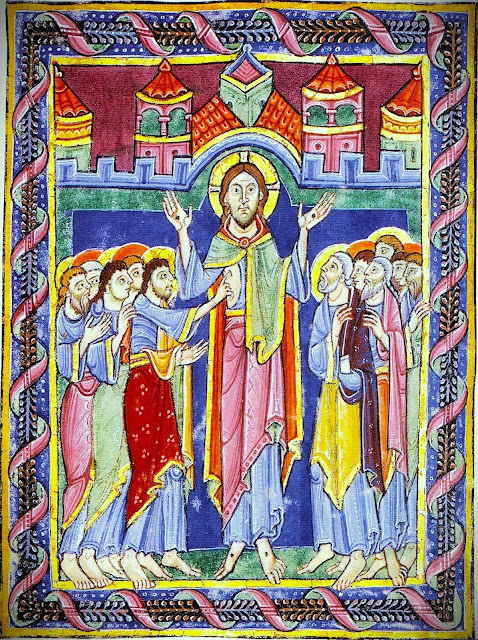
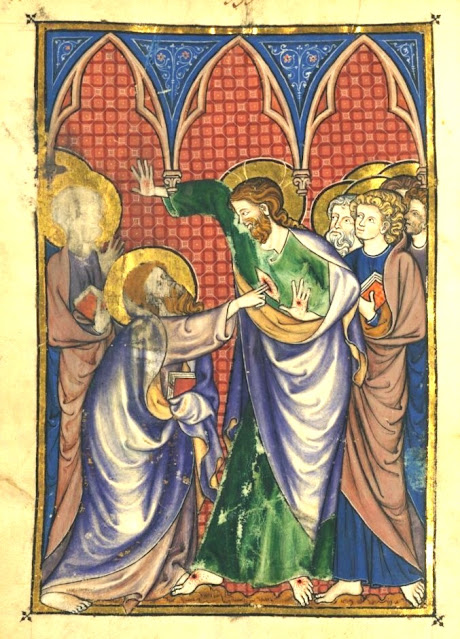
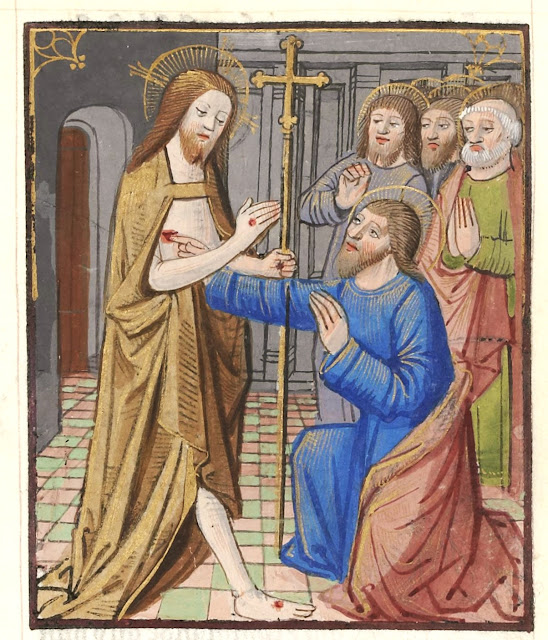
In the iconography of Doubting Thomas, it’s often assumed that he touched the wounds of Jesus. However, the scriptures do not actually say that he touched them, just that Jesus invited him to do so. In the iconography of Saint Thomas that I have gleaned from Margaret Duffy’s amazing website Ad Imaginem Dei, there are at least three different depictions of the story.
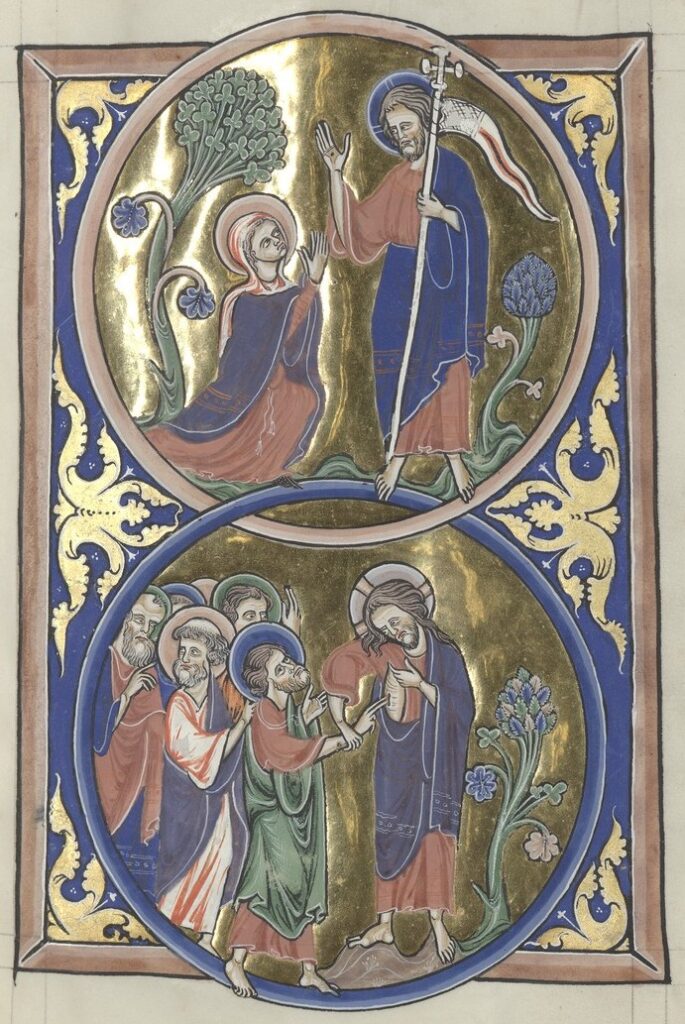
The first iconography is what Duffy names “the moment of touch.” Images 1 and 2 are examples of this type, where Thomas reaches out from a posture that is almost on an eye level with Jesus. She calls the second iconography “the confession of faith” as it seems to depict Thomas kneeling and declaring his belief. Images 3 and 4 are examples of this category, where you can see that Thomas is kneeling with his hand outstretched toward Jesus. And finally, in the third iconography, which Duffy calls “the insistent Jesus,” you can see Jesus actually guiding the hand of Thomas toward his wounds, as shown in Images 5 and 6.
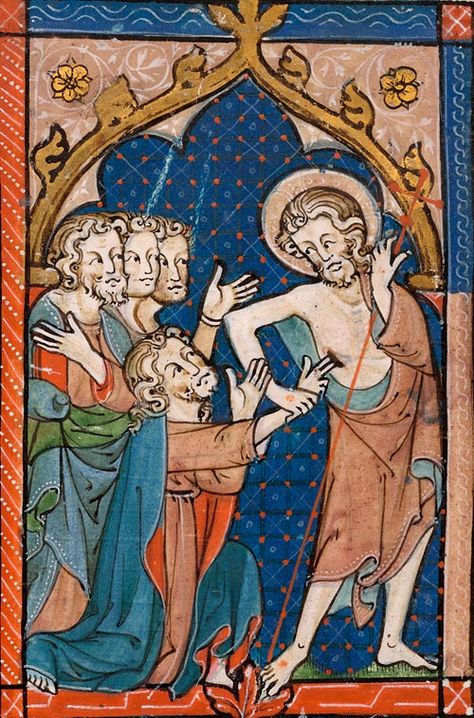
Image 5 is especially interesting because it shows Doubting Thomas directly below an image of Mary Magdalene meeting the resurrected Jesus in the garden near the tomb. To Mary Magdalene, he says noli me tangere or “don’t touch me,” while, at the same time, he concretely encourages Thomas to touch him. Here, according to reference 4, Jesus is responding to their two different needs at the time. Mary needed to not get too attached to his physical body–Jesus is preparing her for his departure later at the ascension, while Thomas needs to reassured that Jesus is really physically present and resurrected.
Reading: The Inclusive New Testament, Priests for Equality, Brentwood, MD, 1994.
Reference 1: Guéranger, Dom. The Commencement of the Great Antiphons, blog post at the Hymns and Carols of Christmas website, referencing Abbott Prosper Louis Paschal Guéranger, O.S.B., The Liturgical Year, Volume 1, Advent. Westminster, MD: The Newman Press, 1948, pp. 483-484. Translation by Dom Laurence Shepherd, O.S.B., circa 1867.
Reference 2: Guéranger, Dom, Saint Thomas Apostle, blog post at the Hymns and Carols of Christmas website, referencing Abbott Prosper Louis Paschal Guéranger, O.S.B., The Liturgical Year, Volume 1, Advent. Westminster, MD: The Newman Press, 1948, pp. 494-499. Translation by Dom Laurence Shepherd, O.S.B., circa 1867.
Reference 3: Guéranger, Dom, December 21, The Liturgical Year by Dom Guéranger, blog post at Liturgia Latina website.
Reference 4: Duffy, Margaret, Iconography of the Resurrection – The Incredulity of St. Thomas (Doubting Thomas), blog post at Ad Imaginem Dei website, May 1, 2011.
Reference 5: Jones, Victoria Emily, The Psalter of Blanche of Castile, blog post at Art & Theology, July 14, 2018.
Image 1: The Incredulity of Thomas from a Life of Barlaam and Joasaph, Byzantine (Greek), circa. 14th Century, Paris, Bibliotheque Nationale de France, MS Grec 1128, fol. 38v.
Image 2: Doubting Thomas from the Psalter of Christina of Markyate, (St. Alban’s Psalter), English manuscript, circa 1124-1145, Hildesheim, Dombibliothek.
Image 3: Master Henri, Doubting Thomas from the Images du Christ et de la Vierge, Belgian (Hainaut), circa 1285-1290, Paris, Bibliotheque Nationale de France, MS NAF 16251, fol. 47v.
Image 4: The Incredulity of Saint Thomas from Le Mirouer de la redemption de l’umain lignage French (Paris), c. 1493-1494, Paris, Bibliotheque Nationale de France MS VELINS-906, fol. 125r.
Image 5: Doubting Thomas detail from the Psalter of St. Louis and Blanche of Castile, circa 1225, Paris, Bibliotheque Nationale de France, MS 1186 reserve, fol. 26r.
Image 6: Illuminated Manuscript, The Morgan Library and Museum, Psalter from England, East Anglia or London, ca. 1300-1310 MS M.302 fol. 3v.





Leave a Reply
Join the conversation by submitting a comment to this blog post below.